
Chapter 1: Event Overview
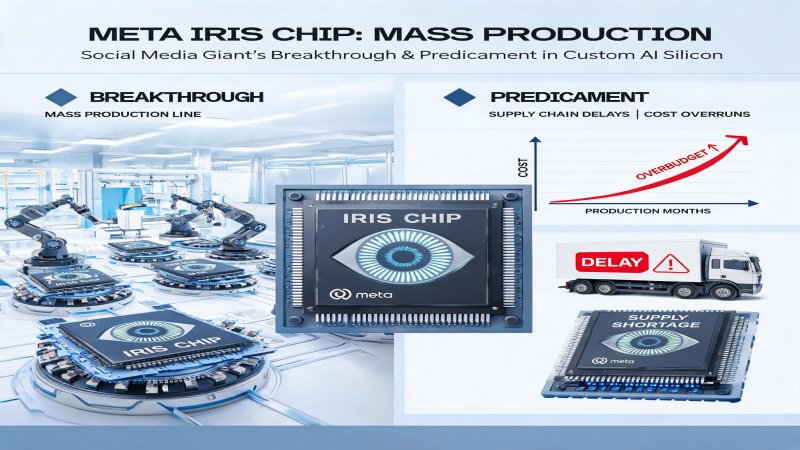
On July 13, 2026, an internal memo exposed by Reuters revealed that Meta Platforms plans to begin mass production of its first custom AI chip, Iris, in September. Designed in collaboration with Broadcom and manufactured by TSMC, Iris is the inaugural product of Meta's four-generation Meta Training and Inference Accelerators (MTIA) project. Meta aims to double overall compute capacity by next year, with Iris as the strategic cornerstone.
Iris's positioning is deliberately tactical: rather than replacing NVIDIA and AMD GPUs entirely, it serves as a complement optimized for recommendation algorithms and inference tasks on Facebook and Instagram. This means Meta's AI chip strategy avoids head-to-head competition with NVIDIA in general AI training, choosing instead to break through in its strongest domain—social recommendation inference.
The timing is noteworthy. Just two months earlier in May 2026, Meta completed a massive layoff affecting approximately 8,000 employees, about 10% of its then 80,000-person workforce. Cuts concentrated in integrity teams, cybersecurity, content design, and Reality Labs, while AI infrastructure, foundation models, and AI monetization teams were protected. Another 7,000 employees were reassigned to newly created AI-focused teams. This reallocation clearly signals Meta's massive resource shift from metaverse and content moderation toward AI infrastructure and custom silicon.
Meta's chip ambitions didn't begin today. As early as 2023, Meta released MTIA v1 inference accelerators for lightweight internal recommendation inference. Iris's mass production marks the critical transition from experimental silicon to large-scale commercial deployment. Broadcom previously disclosed that Meta is its third-largest ASIC customer, contributing approximately $1.5-2 billion annually.
Chapter 2: Technical Depth
Iris's technical architecture warrants deep analysis. As MTIA's first mass-produced generation, Iris employs a domain-specific design optimized for recommendation systems. Unlike general-purpose GPUs, Iris's compute units are hardened for core recommendation operations: sparse embedding lookups, vector dot products, and Top-K sorting.
Industry analysis suggests Iris uses TSMC's 5nm or more advanced 4nm process. Die area is estimated at 400-500 square millimeters with approximately 30-40 billion transistors. Its memory subsystem likely employs High Bandwidth Memory (HBM) or LPDDR5X, with capacity in the 32-64GB range and bandwidth exceeding 1TB/s to meet large-scale recommendation models' demanding memory requirements.
Computationally, Iris may adopt a systolic array design similar to Google TPU but optimized for recommendation sparsity. The core computation involves dot products between massive user embedding vectors and item embedding vectors—typically extremely sparse matrices. General GPUs handle sparse matrices inefficiently, leaving many compute units idle. Iris's dedicated sparse compute units and compressed embedding table designs could improve sparse inference energy efficiency by 3-5x.
Compared to NVIDIA H100, Iris will inevitably lag in general AI training tasks. H100 boasts 80GB HBM3 memory, 3.35TB/s memory bandwidth, and 989 TFLOPS FP8 compute—today's absolute training benchmark. But in recommendation inference scenarios, Iris may achieve higher performance per watt. Estimates suggest Iris could deliver 1.5-2x H100's recommendation inference throughput at equivalent power, at only 30-40% of H100's cost.
Meta also plans to integrate Iris with its Research SuperCluster (RSC), currently equipped with approximately 16,000 GPUs and among the world's fastest AI supercomputers. Iris deployment will first supplement RSC's inference capacity, then expand across Meta's global data center inference infrastructure.
Chapter 3: Financial Logic
Financially, Meta's custom silicon drive centers on cost reduction and capital efficiency. Meta's 2025 capital expenditure was approximately $39.2 billion, with substantial portions funding NVIDIA GPU purchases. At roughly $30,000 per H100, Meta's annual GPU purchases likely exceed 50,000 units.
Custom silicon offers significant long-term financial appeal. While upfront R&D costs are substantial—NRE for advanced ASIC design typically runs $50-100 million—mass production unit costs may reach only 20-30% of equivalent GPUs. Estimates suggest migrating 50% of inference workloads from H100 to Iris could save $1.5-2.5 billion annually in AI infrastructure costs.
Broadcom, as Meta's chip design partner, plays a critical role. Designing TPUs for Google and MTIA for Meta, Broadcom's ASIC business is among the semiconductor industry's fastest-growing segments. CEO Hock Tan previously projected AI revenue of $15-20 billion in 2026, with Meta contributing approximately $1.5-2 billion. For Meta, Broadcom collaboration eliminates the need to build chip design teams from scratch, dramatically lowering barriers and risks.
However, financial returns face significant time delays. From tape-out to mass production typically requires 12-18 months, with yield ramp-up needing another 6-12 months. This means Iris's scaled cost advantages may not fully materialize until H2 2027. Meanwhile, Meta must continue purchasing NVIDIA GPUs for training needs.
Chapter 4: Strategic Depth
Meta's custom silicon strategy must be viewed against the global AI compute competition landscape. Currently, tech giants are pursuing custom chips, creating a complex competitive picture.
Google is the trend's pioneer. The TPU project began in 2013, now at v5p, serving internal Search, YouTube, and DeepMind while offering compute rentals through Google Cloud. TPU maturity provides significant AI training cost advantages and serves as Google Cloud's key differentiator.
Amazon's Trainium and Inferentia series pursue a different strategy: primarily serving AWS customers as low-cost NVIDIA alternatives. Amazon doesn't attempt absolute performance supremacy but captures market share through cost-effectiveness and deep AWS integration.
Microsoft's position is most nuanced. As OpenAI's largest investor and cloud partner, Microsoft maintains close NVIDIA ties. But Microsoft is also developing Maia AI chips, reportedly delayed by at least six months with mass production pushed from 2025 to 2026.
| Vendor | Custom Chip | Process | Core Scenario | 2026E Shipment | Ecosystem Strategy |
|---|---|---|---|---|---|
| Meta | Iris (MTIA) | 4/5nm | Recommendation Inference | Hundreds of thousands | Primarily internal |
| TPU v5p | 4nm | Training + Inference | Millions | Internal + External | |
| Amazon | Trainium2/Inferentia2 | 5nm | Training + Inference | Hundreds of thousands | AWS cloud service |
| Microsoft | Maia | 5nm | Training + Inference | Small scale | Azure integration |
| NVIDIA | H100/H200/B100 | 4nm | General AI | Millions | Open ecosystem |
Chapter 5: Challenges and Risks
Despite promising prospects, Meta's custom silicon path faces numerous challenges.
First, technical risk. Recommendation models are evolving rapidly—from traditional two-tower models to Transformer-based sequential recommendations to multimodal recommendations. Architecture shifts could quickly obsolete chips optimized for specific operations. Google TPU's success partly stems from relative architectural generality accommodating multiple model types. Iris's highly specialized design boosts short-term efficiency but increases architecture rigidity risk.
Second, supply chain risk. TSMC's advanced process capacity is extremely tight, with Apple, NVIDIA, and AMD all competing for allocation. As a new ASIC customer, Meta's priority may fall below these established giants. If Iris production encounters yield issues or capacity bottlenecks, Meta may be forced to continue expensive GPU purchases, offsetting custom silicon cost advantages.
Third, ecosystem lock-in risk. Meta's AI infrastructure is deeply bound to PyTorch, which is most maturely optimized for NVIDIA GPUs. Migration to custom chips requires rebuilding software stacks and re-optimizing models, consuming engineering resources while potentially introducing performance and stability issues. Google TPU spent years establishing relatively mature XLA compilers and TensorFlow ecosystems; Meta faces even greater challenges.
Fourth, organizational challenges. Custom silicon requires deep collaboration across hardware, software, and algorithm teams. While Meta protected AI infrastructure teams in May 2026 layoffs, Reality Labs cuts may have weakened specialized hardware engineering capabilities. Meanwhile, recruiting top chip design talent externally is increasingly difficult amid persistent industry-wide talent shortages.
Chapter 6: Conclusion
For technology procurement decision-makers, Meta's Iris mass production signals that custom silicon for ultra-large-scale specialized inference workloads has achieved commercial viability. Enterprises with similar scenarios—massive user bases, recommendation-driven, inference-heavy—should evaluate custom or bespoke ASIC feasibility. But for most enterprises, NVIDIA GPUs remain optimal for the next 3-5 years given generality, ecosystem maturity, and supply chain stability.
For investors, Meta's custom silicon strategy is a key catalyst for capital efficiency improvement. If Iris achieves scaled deployment in 2027, Meta's AI infrastructure cost curve will shift significantly downward, unlocking billions in free cash flow for AI model R&D and content investment. Monitor Meta's Q3 and Q4 2026 earnings guidance for AI infrastructure CapEx changes, plus initial Iris performance benchmark results post-production.
For AI practitioners, Meta's MTIA project represents an important evolution in recommendation system infrastructure. Track Meta's shared Iris optimization experiences in academic conferences and open-source communities, particularly sparse computation, embedding compression, and inference pipeline innovations. These techniques apply beyond Meta's scenarios, potentially informing broader recommendation system optimization.
Overall, Meta Iris chip mass production marks a significant milestone in AI infrastructure. It signals tech giants' strategic shift from passive GPU procurement to active chip customization entering a new phase. While the path ahead brims with challenges, for companies with sufficient scale and scenario focus, custom silicon is becoming an indispensable strategic capability in AI competition.
Why it Matters
Meta Iris chip mass production marks tech giants' transition from experimental to scaled commercial AI silicon deployment. In recommendation systems, specialized chips may achieve 3-5x GPU energy efficiency. This trend will accelerate data center de-NVIDIAization, pushing ASIC market share from approximately 15% to over 30% by 2028.
DECISION
Hyperscalers: Evaluate custom ASIC feasibility, prioritizing high-volume, homogeneous inference scenarios.
General enterprises: Continue NVIDIA GPU-centric strategy for 3-5 years, monitoring AMD MI series and Intel Gaudi cost-performance evolution.
Investors: Track Meta's H2 2026 CapEx guidance and initial Iris benchmark results as key signals for custom silicon ROI.
PREDICT
Next 3 months: First Iris engineering samples will reach Meta data centers for integration testing, with software stack adaptation issues expected.
Next 6 months: If production proceeds smoothly, Meta will reduce 2027 AI infrastructure CapEx guidance by 5-10% in Q4 2026 earnings.
Next 12 months: Google and Amazon will accelerate TPU and Trainium external rental businesses, competing more directly with NVIDIA.
Next 24 months: Specialized inference chip data center penetration will rise from 15% to 25%, with training remaining NVIDIA-dominated.
Get 3-5 key AI infrastructure signals weekly →
💬 Comments (0)