
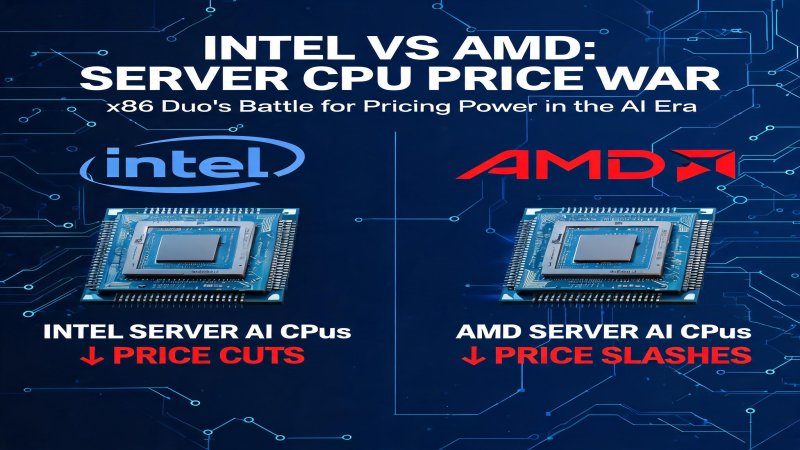
I. Event Recap: CPUs Join the Price Hike Camp
In July 2026, the server CPU market saw a rare wave of price increases. Intel confirmed on July 5 that it had raised official recommended prices for select consumer and server processors, less than two months after the previous adjustment. In the server segment, increases were particularly significant: flagship Xeon 6980P (128C/256T) rose from $12,460 to $13,955, up approximately 12%; Xeon 6952P (96C) increased by $1,094; Xeon 6962P (72C) rose by $1,191. Previous-generation Emerald Rapids Xeon 8592+ (64C) now costs $12,992, up $1,392 from 2025 and exceeding its original 2023 launch price.
Intel stated that price adjustments reflect evolving market dynamics and ongoing supply chain cost monitoring. Notably, all Xeon processors are manufactured in-house by Intel, so this increase does not stem from external foundry cost increases.
Almost simultaneously, AMD formally notified key AIB partners of GPU core and GDDR memory bundle price increases of approximately 10%, effective July 2026. Goldman Sachs issued a research report on July 6, raising AMD's price target from $450 to $640, an increase exceeding 42%. Capital markets responded enthusiastically: on July 6, US chip stocks rebounded sharply, with the Philadelphia Semiconductor Index up 4.2% and AMD gaining 7.9%.
This round of price increases marks the end of the long-running "prices only fall, never rise" logic in the CPU market. In the industry's view, AI-driven compute demand is fundamentally reshaping traditional CPU market supply-demand dynamics.
II. Technical Deep Dive: Granite Rapids vs. EPYC Architecture Showdown
The core products of Intel's price increase are 6th Gen Xeon Scalable processors based on the Granite Rapids architecture, while AMD's primary competing product is the EPYC 9005 series based on the Zen 5 architecture. Differences in their technical approaches determine their distinct positioning in AI workloads.
Intel Granite Rapids uses Intel 3 process (equivalent to 7nm), emphasizing high core counts and memory bandwidth. Flagship 6980P offers 128C/256T, supports 12-channel DDR5-6400 memory, with maximum memory capacity up to 6TB. Its key innovation is the integrated AI acceleration engine (AMX, Advanced Matrix Extensions), enabling INT8 and BF16 matrix operations per core with theoretical AI inference performance reaching tens of TOPS.
AMD EPYC 9005 Series uses TSMC 4nm process, with clear advantages in power efficiency. Flagship 9965 offers 128C/256T, supports 12-channel DDR5-4800 memory, but with larger L3 cache (32MB per CCD, totaling over 512MB) and higher IPC, it excels in traditional enterprise workloads like databases and virtualization.
In AI inference scenarios, competition is more complex. For lightweight AI inference (recommendation systems, small NLP models), Granite Rapids' AMX engine provides native hardware acceleration with lower latency. For large-scale parallel inference (batch image recognition), EPYC's core density and memory bandwidth offer advantages.
| Technical Spec | Intel Xeon 6980P | AMD EPYC 9965 |
|---|---|---|
| Cores/Threads | 128C/256T | 128C/256T |
| Process | Intel 3 (7nm) | TSMC 4nm |
| Base/Boost Clock | 2.0/3.2 GHz | 2.25/3.5 GHz |
| L3 Cache | 504 MB | 512 MB |
| Memory Channels | 12x DDR5-6400 | 12x DDR5-4800 |
| Max Memory | 6 TB | 6 TB |
| TDP | 500W | 400W |
| AI Acceleration | AMX (INT8/BF16) | AVX-512 VNNI |
| Launch | Q4 2024 | Q4 2024 |
| July 2026 Price | $13,955 | ~$12,500 (est.) |
III. Financial Logic: Gross Margin Recovery Strategy
The core driver of Intel's price increase is not cost inflation but gross margin recovery strategy. In 2024, Intel's data center revenue was approximately $18 billion, but operating margin was only around 8%, far below NVIDIA's data center operating margin exceeding 70%. CEO Lip-Bu Tan has made improving profitability his top priority.
For Xeon 6980P, die size is approximately 800mm² using Intel 3 process. Industry estimates suggest approximately 60-70 dies per wafer, yielding about 50 good dies after yield adjustments. At approximately $15,000 wafer manufacturing cost, per-die manufacturing cost is about $300. The $13,955 selling price implies gross margin exceeding 95%—even accounting for packaging, testing, and R&D amortization, comprehensive gross margin remains above 80%.
AMD's data center business (CPU and GPU) generated approximately $12 billion in 2025 revenue with operating margin around 25%. Goldman's 42% price target increase to $640 is based on continued data center CPU share gains, AI accelerator business (MI350 series) potentially doubling within two years, and ongoing favorable competitive dynamics against Intel in the server market.
Financially, this price increase represents tacit cooperation between the x86 duo amid AI compute demand explosion—neither wishes to continue price wars, instead jointly raising ASP to fund next-generation technology development.
IV. Strategic Depth: x86 vs. ARM vs. Custom Silicon
The x86 architecture holds over 90% server market share, but this dominance faces unprecedented challenges.
ARM's rise is the most direct threat. AWS Graviton4, AmpereOne, and Huawei Kunpeng 920 have achieved substantial deployment in cloud computing, big data, and edge computing. ARM's power efficiency advantage (typically 30-50% better performance-per-watt than x86) makes it highly attractive for AI inference and high-density computing. KeyBanc raised ARM Holdings' price target from $170 to $300 on July 5, based on expectations of rapidly accelerating ARM data center penetration.
Cloud vendor custom silicon is another major variable. AWS Trainium3 and Inferentia3, Google TPU v6, and Microsoft Maia 200 are all eroding the traditional CPU+GPU architecture market. These custom chips are deeply optimized for specific AI workloads, often delivering better price-performance than general-purpose x86 processors.
| Dimension | Intel Xeon | AMD EPYC | ARM (AWS Graviton4) | Custom Silicon |
|---|---|---|---|---|
| Ecosystem Maturity | Extremely High | High | Medium | Low (proprietary) |
| Single-Core Performance | High | High | Medium | Workload-dependent |
| Power Efficiency | Medium | Medium-High | High | Extremely High |
| Native AI Acceleration | AMX | AVX-512 | SVE2 | Custom architecture |
| Software Compatibility | Widest | Wide | Moderately Wide | Requires porting |
| Price Competitiveness | Reduced post-hike | Reduced post-hike | High (30% lower TCO) | Highest (internal use) |
| Key Customers | Traditional enterprises, cloud | Cloud, HPC | AWS, some clouds | Internal clouds only |
Intel's response focuses on advanced packaging (EMIB) and glass substrates, attempting to compensate for process disadvantages through packaging innovation. CEO Tan has set a goal of 10x shareholder returns within 5-10 years, centered on advanced packaging, glass substrates, and novel semiconductor materials (GaN, SiC, InP).
AMD's strategy is "performance first + foundry flexibility." Through close collaboration with TSMC, AMD maintains a 1-1.5 generation process lead over Intel. AMD is also launching its own 72-chip server racks, competing directly with NVIDIA in AI infrastructure.
V. Challenges and Risks: Price Hikes Are a Double-Edged Sword
While improving short-term profitability, this price increase carries multiple long-term risks.
First, customer churn risk. Data center buyers are highly price-sensitive. A typical dual-socket server sees CPU costs rise from $24,920 to $27,910, adding $2,990. For large data centers deploying thousands of servers, this means millions in additional spend. Some customers may accelerate ARM alternative evaluation.
Second, accelerated custom silicon substitution. AWS, Google, and Microsoft already have internal chip teams. x86 CPU price hikes directly increase the economic attractiveness of their custom chips. AWS Graviton4's price-performance advantage expands further post-x86 hikes.
Third, AI workload migration to GPUs/accelerators. As AI models scale, increasing training and inference workloads shift from CPUs to GPUs and dedicated AI accelerators. This means CPU value share in AI data centers is declining, and price hikes may further weaken competitiveness.
Fourth, supply chain backlash. Simultaneous Intel and AMD price hikes may trigger pushback from downstream server vendors (Dell, HPE, Lenovo). These ODM/OEMs already operate on thin margins, and CPU price increases squeeze their profitability, potentially making them more inclined to promote ARM architecture servers to diversify risk.
Fifth, Intel's manufacturing struggles. Despite improved financials from price hikes, Intel's catch-up in advanced processes (Intel 18A and beyond) remains challenging. TSMC's 2nm process is expected in mass production by late 2025, while Intel's 18A process won't reach mass production until H2 2026, with yield uncertainty remaining.
VI. Conclusion: Endgame Scenarios for Pricing Power
The Intel-AMD server CPU price war represents the x86 architecture's attempt at value reassessment in the AI era. As AI compute demand continues expanding, CPU pricing logic is shifting from "performance-driven" to "compute tax-driven"—customers paying higher premiums per unit of compute.
For data center procurement decision-makers, recommended strategies include:
- Short-term (6-12 months): x86 CPU prices have entered an upward channel. Complete necessary server procurement before Q3 2026 to avoid further increases. For new AI inference clusters, pilot ARM architecture servers (AWS Graviton4 or AmpereOne) to evaluate TCO advantages in specific workloads.
- Medium-term (1-2 years): Closely monitor Intel 18A process and AMD Zen 6 architecture progress. If Intel achieves yield breakthroughs in H2 2026, its process disadvantage narrows significantly; if AMD maintains TSMC foundry advantages, its market share may expand further.
- Long-term (3-5 years): Evaluate cloud vendor custom silicon erosion speed on the x86 market. If AI workloads further concentrate on dedicated accelerators, general-purpose CPU market growth may slow to single digits. Reserve migration paths to ARM and RISC-V in architectural planning.
Predictions:
- Q3 2026: Intel and AMD server CPU prices stabilize, but shipments may decline QoQ due to customer pull-ins. ARM server market share may rise from current 8% to 10%.
- H1 2027: AMD Zen 6 and Intel Granite Rapids-AP (advanced packaging version) launch successively, with competition intensifying in core density and memory bandwidth.
- H2 2027: If cloud vendor custom silicon price-performance advantages continue expanding, x86 value share in AI data centers may decline from approximately 30% to 25%.
- 2028: The server CPU market may evolve into a three-tier structure of "x86 primary, ARM secondary, custom silicon supplementary," with Intel and AMD's combined market share potentially declining from 90% to approximately 80%.
Why it Matters
The x86 architecture holds over 90% server market share, but ARM and cloud vendor custom silicon are accelerating erosion. Intel and AMD's synchronized price hikes improve profitability short-term but may accelerate customer migration long-term. Global cloud vendor capex is projected at $830 billion in 2026, with AI infrastructure investment as the core driver. Whether the x86 duo can maintain pricing power in the AI era will determine the data center chip market landscape for the next five years.
DECISION
Data center procurement managers: Complete necessary server procurement before Q3 2026 to avoid further increases; pilot ARM architecture servers for new AI inference clusters to evaluate TCO advantages.
Investors: AMD's process and power efficiency advantages provide greater resilience during the price hike cycle; Intel's gross margin recovery depends on 18A process progress.
Technical architects: Reserve ARM and RISC-V migration paths in architectural planning to reduce x86 over-dependence.
PREDICT
Q3 2026: x86 CPU prices stabilize, shipments decline QoQ due to pull-ins; ARM server share rises from 8% to 10%.
H1 2027: AMD Zen 6 and Intel Granite Rapids-AP launch, intensifying core density competition.
H2 2027: If cloud vendor custom silicon advantages expand, x86 value share in AI data centers may decline from 30% to 25%.
2028: Server CPU market may evolve into a three-tier structure with x86 primary, ARM secondary, and custom silicon supplementary; combined x86 share may decline from 90% to approximately 80%.
Get 3-5 key AI infrastructure signals weekly →
💬 Comments (0)