
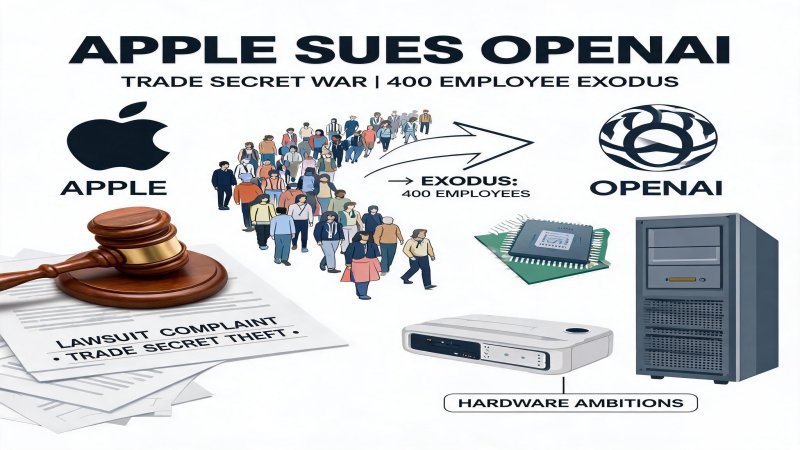
I. Event RecapOn July 10, 2026, Apple filed a 41-page complaint in the U.S. District Court for the Northern District of California against OpenAI and two former employees, Zhang Liu and Tang Tan. The allegations describe systematic theft of trade secrets. Zhang, a senior systems electrical engineer with 8 years at Apple, allegedly failed to return a company laptop and exploited authentication vulnerabilities to download dozens of confidential hardware files, including a 1,000-page technical compilation. Tang, a 20-year Apple veteran and former VP of Product Design for iPhone and Apple Watch, allegedly emailed supplier information to his personal account before leaving, and later instructed job candidates to bring Apple product parts to OpenAI interviews. Apple revealed that over 400 former Apple employees now work at OpenAI. The lawsuit was filed just weeks after OpenAI confidentially submitted its IPO filing to the SEC, targeting a $1 trillion valuation.
二、技术纵深
本案的核心技术焦点在于
消费硬件设计
——这是一个Apple统治了二十年、而OpenAI正试图从零构建的领域。
OpenAI的硬件野心并非秘密。2025年,OpenAI以
65亿美元
收购Jony Ive(Apple前首席设计官)创立的io Products,获得了约55名硬件工程师,并让Ive全面接管OpenAI的创意与设计职责。这一步棋的战略意图极为明确:OpenAI不想永远做iPhone里的一个ChatGPT功能,它要做自己的硬件,绕过Apple直接和消费者建立关系。
Apple在诉状中指控OpenAI窃取的机密信息涵盖多个关键技术领域:
电路板制造细节
:张刘下载的1000页技术文件汇编完整记录了Apple硬件复杂电路板的制造工艺,包括层叠结构、信号完整性设计、电源管理架构等核心知识。
供应商网络
:陈友丹被指控带走的供应商信息涉及Apple精心构建了二十多年的供应链体系,包括关键零部件的规格、价格、交货周期和质量标准。
在研产品信息
:作为前iPhone和Apple Watch设计副总裁,陈友丹掌握Apple未来2-3年的产品路线图和工业设计方向。
OpenAI的硬件战略正在全面复制Apple的"软硬一体"模式:
能力维度
Apple路径
OpenAI路径
设计能力
Jony Ive团队(1998-2019)
Jony Ive + io Products(2025-)
工程能力
内部硬件工程团队(>10000人)
从Apple挖角400+工程师
芯片能力
Apple Silicon(A系列/M系列)
Jalapeño自研推理芯片(与Broadcom合作)
操作系统
iOS/macOS/watchOS
基于ChatGPT的AI原生交互
生态锁定
iCloud/App Store/服务生态
订阅制+Agent生态
2026年6月,OpenAI与Broadcom联合发布了首款定制AI推理芯片Jalapeño,计划2026年底正式部署。这标志着OpenAI在芯片层面的自主化迈出了关键一步。分析师普遍认为,OpenAI正在秘密开发自己的手机或其他硬件设备,首款AI设备可能在2026年下半年面世,目标出货1亿台。
II. Technical Depth
The technical core of this case is consumer hardware design—Apple's two-decade stronghold that OpenAI is attempting to build from scratch. In 2025, OpenAI acquired Jony Ive's io Products for $6.5 billion, gaining approximately 55 hardware engineers and placing Ive in charge of creative and design direction. Apple's complaint alleges theft of confidential information spanning PCB manufacturing details, supplier networks, and unreleased product roadmaps. OpenAI is replicating Apple's "integrated hardware-software" model through design (Ive), engineering (400+ former Apple hires), silicon (Jalapeño AI inference chip co-developed with Broadcom), and AI-native interaction paradigms. The first OpenAI hardware device is rumored for H2 2026 with a target shipment of 100 million units.
三、财务逻辑
这场诉讼的财务影响是双向的,对Apple和OpenAI都构成了重大风险。
OpenAI的IPO风险
:OpenAI当前估值超过8500亿美元,目标在2026年Q4以1万亿美元估值完成IPO。苹果在诉状中要求法院判令OpenAI停止使用相关商业秘密、销毁所有Apple专有资料,并
重新设计其待发布产品
——确保其中不包含任何Apple技术。如果法院支持这一诉求,对一家即将上市公司的影响将是灾难性的:产品延期、研发成本重估、投资者信心崩塌。
以65亿美元收购的io Products及其硬件团队,其核心价值可能因产品重新设计而大幅缩水。如果OpenAI的首款硬件设备被迫推迟6-12个月,错失2026年下半年的市场窗口,其1亿台出货目标将化为泡影。按照消费电子行业平均毛利率30%、均价500美元估算,这相当于150亿美元的潜在收入损失。
Apple的财务立场
:Apple 2025财年硬件收入约3200亿美元,iPhone占比约52%。如果OpenAI成功推出具有竞争力的AI硬件设备,直接威胁的不仅是Apple的市场份额,更是其封闭的生态系统。Apple的服务业务(App Store、iCloud、Apple Music等)年收入已超900亿美元,这些服务的根基是硬件设备的保有量。任何削弱Apple硬件地位的竞争对手,都会对其高毛利的服务业务产生连锁反应。
从诉讼成本角度看,Apple在此案中投入的法律资源预计将达到数千万美元级别,但相对于保护其万亿市值的核心竞争力而言,这是必要的防御性支出。斯坦福大学法学院教授马克·莱姆利指出,如果Apple能够证明员工带走了机密文件且OpenAI正在使用这些文件,"那对OpenAI而言就麻烦了"。
III. Financial Logic
The financial implications are bidirectional and substantial. OpenAI, valued at over $850 billion and targeting a $1 trillion IPO in Q4 2026, faces catastrophic risk if the court orders it to cease use of trade secrets and redesign upcoming products. The $6.5 billion io Products acquisition could be significantly impaired. A 6-12 month product delay would wipe out the rumored 100 million unit shipment target—potentially $15 billion in lost revenue assuming a $500 average selling price and 30% gross margin. For Apple, hardware revenue totaled approximately $320 billion in FY2025, with iPhone at 52%. Its services ecosystem generating over $90 billion annually depends on hardware installed base. Legal defense costs will reach tens of millions, but are negligible compared to protecting trillion-dollar competitive moats.
四、战略纵深
本案的本质是AI时代平台控制权的争夺。Apple和OpenAI从2024年的盟友变成了2026年的敌人,这一转变折射出科技产业权力结构的深刻变化。
从合作到对抗的时间线
:
2024年:Apple将ChatGPT深度整合进iOS、iPadOS和macOS,用户可通过Siri直接调用ChatGPT。这是Apple在AI领域落地的第一个重大对外合作项目。
2025年:OpenAI以65亿美元收购io Products,获得Jony Ive及其硬件设计团队。同年,超过200名Apple员工跳槽至OpenAI。
2026年6月:Apple在WWDC上发布全新Siri,背后的AI底座从ChatGPT换成了Google的Gemini。同月,OpenAI发布自研芯片Jalapeño。
2026年7月10日:Apple正式起诉OpenAI。
竞争对比矩阵:Apple vs OpenAI vs Google vs Meta
维度
Apple
OpenAI
Meta
核心优势
硬件设计+生态系统
大模型+人才吸引力
搜索+云+Android
社交+VR/AR
AI硬件策略
Apple Intelligence(端侧)
自研AI原生设备
Pixel+云端Gemini
Quest+Ray-Ban智能眼镜
自研芯片
M系列/A系列(行业领先)
Jalapeño(起步阶段)
TPU(云侧为主)
MTIA(与三星合作)
2025年营收
约3910亿美元
约85亿美元
约3500亿美元
约1620亿美元
市值/估值
约3.5万亿美元
8500亿美元(目标1万亿)
约2.3万亿美元
约1.5万亿美元
用户规模
23亿活跃设备
4亿周活ChatGPT用户
Android 30亿设备
日活30亿人
硬件利润率
约35-40%
N/A(尚未发售)
硬件微利
VR硬件亏损
供应链控制
极强(台积电优先产能)
依赖代工
中等
中等
Apple的战略困境在于:它无法在AI模型层面与OpenAI正面竞争(Apple Intelligence依赖外部模型),但它在硬件设计和用户体验上拥有二十年积累。OpenAI的困境则相反:它拥有最强大的AI模型和顶尖人才吸引力,但缺乏硬件制造经验、供应链关系和规模化生产能力。
Google的角色值得特别关注。当Apple在WWDC 2026上用Gemini替换ChatGPT时,这不仅是技术选择,更是地缘政治信号——Apple需要一个足够强大、但又不会直接威胁其硬件业务的AI伙伴。Google的Pixel手机年销量不足Apple的5%,因此双方在硬件层面不存在直接竞争。
IV. Strategic Depth
This lawsuit is fundamentally about platform control in the AI era. Apple and OpenAI transitioned from 2024 partners to 2026 adversaries, reflecting a structural power shift. Apple's 2025 revenue was approximately $391 billion with 2.3 billion active devices, while OpenAI reached roughly $8.5 billion revenue with 400 million weekly ChatGPT users but zero hardware shipments. OpenAI's acquisition of io Products for $6.5 billion and its Jalapeño chip development signal intent to replicate Apple's integrated model. Google's substitution for ChatGPT in Apple Intelligence at WWDC 2026 reflects Apple's need for an AI partner that doesn't threaten its hardware business—Pixel sells less than 5% of iPhone volume. Meta's MTIA accelerator, reportedly being manufactured by Samsung on 2nm process, adds another competitive vector.
五、挑战与隐忧
OpenAI面临的法律与商业风险
:
- IPO进程受阻
:诉讼曝光可能在SEC审查阶段引发重大问题。如果Apple成功申请到初步禁令,OpenAI可能被迫推迟产品发布,进而影响IPO时间表和估值。
- 加州法律的灰色地带
:加州法律允许员工跳槽至竞争对手(这本身就是硅谷创新生态的基础),但禁止带走商业机密。罗格斯大学法学教授卡米拉·赫尔迪指出,此前大多数涉及AI和商业机密的案件都涉及软件,而这次是硬件——法律先例更少,结果更难预测。
- 人才招聘的寒蝉效应
:此案可能使其他公司的员工对加入OpenAI产生顾虑,担心被前雇主起诉或卷入法律纠纷。
- 产品重新设计的成本
:如果法院要求OpenAI重新设计其待发布产品以排除Apple技术,研发成本和时间损失可能达到数亿美元级别。
Apple面临的风险
:
- 诉讼失败的声誉损失
:如果Apple无法证明OpenAI实际使用了其商业机密,这场高调的诉讼可能适得其反,被视为对创新竞争的打压。
- 公众对"大公司霸凌"的观感
:OpenAI在公众舆论中拥有"创新者"和"AI民主化推动者"的形象,Apple的诉讼可能被解读为对初创企业的打压。
- AI合作伙伴关系的损害
:此案可能使其他AI公司不愿与Apple合作,担心未来也可能成为诉讼对象。
V. Challenges and Risks
OpenAI faces multiple legal and commercial risks: IPO process disruption if preliminary injunctions are granted; uncertain legal precedent since hardware trade secret cases are rarer than software disputes in AI; chilling effects on talent recruitment; and potential hundreds of millions in redesign costs if the court orders product modifications. Apple faces reputational risk if it cannot prove actual use of trade secrets by OpenAI, potential public perception of "big company bullying," and damage to future AI partnership opportunities. Professor Camilla Hrdy of Rutgers Law notes this case breaks new ground because most AI-related trade secret litigation has involved software, not hardware.
六、结论
Apple诉OpenAI案不仅是一起商业机密纠纷,更是AI时代产业权力重组的缩影。它揭示了三个关键趋势:
第一,AI公司正在"硬件化"
。OpenAI、Anthropic等纯软件AI公司正在通过收购、挖角和自研芯片进入硬件领域,这不可避免地会与Apple、Samsung等传统硬件巨头发生冲突。
第二,人才流动已成为战略武器
。400人从Apple流向OpenAI,这不仅是一次人才迁移,更是一次知识转移。在高度依赖隐性知识的硬件设计领域,人的流动意味着技术的流动。
第三,诉讼将成为AI竞争的常规手段
。随着AI公司向硬件扩张、硬件公司向AI升级,类似的知识产权纠纷将越来越频繁。本案的判决结果将为未来的类似案件设立重要先例。
针对不同角色的建议
:
投资者
:密切关注OpenAI IPO进程中的法律风险披露。如果Apple获得初步禁令,OpenAI的估值可能面临15-25%的下调压力。同时关注Apple服务业务的增长韧性——如果硬件业务受到AI设备冲击,服务业务将是关键缓冲。
企业采购决策者
:OpenAI硬件产品的上市时间可能因诉讼推迟6-12个月。如果计划在2026-2027年部署AI硬件,应保持对Google、Meta和Apple方案的并行评估。
科技从业者
:此案再次提醒,跳槽时处理前雇主机密信息的边界至关重要。即使在加州这样保护员工流动性的司法管辖区,带走或分享商业机密仍然可能面临严重的民事甚至刑事责任。
VI. Conclusion
This case represents more than a trade secret dispute—it is a microcosm of industrial power restructuring in the AI era. Three trends are evident: AI companies are "hardware-izing" through acquisitions and chip development; talent flow has become a strategic weapon, with 400 Apple-to-OpenAI transfers representing knowledge migration; and litigation will become a standard competitive tool as AI and hardware domains collide. For investors, monitor OpenAI's IPO risk disclosures—an Apple preliminary injunction could trigger a 15-25% valuation haircut. Enterprise buyers should maintain parallel evaluation of Google, Meta, and Apple AI hardware strategies given potential 6-12 month delays to OpenAI devices. Technology professionals should note that even in employee-friendly jurisdictions like California, misappropriation of trade secrets carries severe civil and criminal liability.
免责声明:
本文仅为信息分析和行业研究之用,不构成投资建议、法律建议或采购建议。所有数据均来自公开报道,作者不对其准确性和完整性承担责任。
Why it Matters
This is one of the largest IP disputes in the AI era. Apple demands OpenAI cease using trade secrets and redesign pending products—if granted, OpenAI's $1 trillion IPO valuation could face a 15-25% haircut. It marks the first direct conflict between AI companies expanding into hardware and established hardware giants, setting a critical legal precedent for the industry.
DECISION
Investors: Monitor OpenAI IPO risk disclosures closely; reduce positions if Apple obtains preliminary injunction. Enterprise buyers: Expect 6-12 month delays to OpenAI hardware; maintain parallel evaluation of Google and Apple solutions. Tech professionals: Strictly distinguish personal knowledge from former employer trade secrets when changing jobs.
PREDICT
Q3 2026: Apple may seek a preliminary injunction to halt OpenAI hardware development. Q4 2026: OpenAI IPO may adjust valuation range to $700-800 billion due to litigation pressure. H1 2027: Case enters discovery phase; more former Apple employees may be subpoenaed. H2 2027: If OpenAI hardware requires redesign, product launch could be delayed to 2028.
Get 3-5 key AI infrastructure signals weekly →
💬 Comments (0)