
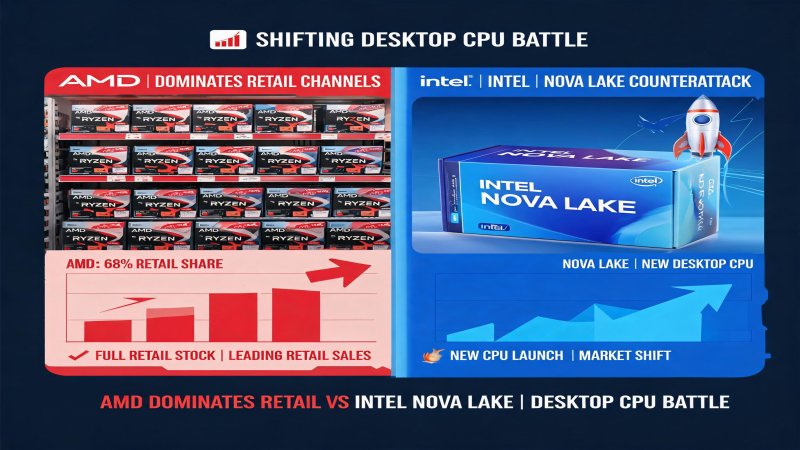
<h2>I. Event Recap: AMD Retail Dominance and Intel Architecture Leaks</h2><p>On July 8, 2026, two nearly simultaneous news items outlined a profound shift in the desktop CPU market. First, Micro Center CEO Rick Machad confirmed AMD Ryzen as the channel's gaming desktop CPU sales champion, occupying eight of the top ten bestseller slots. Second, sources detailed Intel's next-gen Nova Lake GPU architecture—only the 12Xe high-end iGPU upgrades to Xe3P, while lower tiers remain on Xe3 IP, and the 4P+0E CPU module will use Intel's own 18AP process.</p><p>AMD's retail dominance extends far beyond Micro Center. Amazon's CPU top ten shows AMD at eight positions; Newegg shows AMD at nine, with the top four entirely AMD-led, 9800X3D and 5800X3D taking first and second. On the GPU side, one in three desktop gaming GPUs sold at Micro Center is AMD Radeon, with RX 9070 XT launch demand exceeding even the most optimistic forecasts.</p><p>Intel's Nova Lake news reveals its struggles with process and architecture. As the 4th-gen Core Ultra, Nova Lake's 4P+0E module uses Intel 18AP while other CPU modules rely on TSMC N2P outsourcing. This hybrid "partial in-house, partial outsourced" approach reflects both Intel's 18A ambition and its inability to achieve advanced process self-sufficiency.</p><h2>II. Technical Deep Dive: 3D V-Cache vs Xe3P</h2><p>AMD's sustained CPU dominance rests on 3D V-Cache. By vertically stacking additional SRAM cache layers atop CPU dies, 3D V-Cache boosts L3 capacity from 32-64MB to 96-128MB, delivering 15-25% performance gains in cache-sensitive workloads like gaming. The X3D series (7800X3D, 9800X3D, 9950X3D) has become synonymous with gaming CPUs, often outperforming similarly priced Intel processors by 20%+ at 1080p and 1440p.</p><p>Technically, 3D V-Cache uses TSMC's SoIC packaging with hybrid bonding for direct copper interconnects at under 9μm pitch. This increases cache, reduces latency, and lowers power. AMD has confirmed AM5 platform support through 2029+, meaning users can upgrade to latest architectures without motherboard replacement—dramatically lowering upgrade costs.</p><p>Intel Nova Lake's technical highlight is the GPU. Xe3P represents Intel's third-generation discrete GPU architecture, significantly improving ray tracing and AI inference over Xe2. However, only the 12Xe high-end iGPU gets the upgrade; 4Xe and 2Xe tiers remain on Xe3 IP. While this prioritizes high-performance users, mainstream users see continued graphics lag. The hybrid manufacturing—4P+0E on 18AP, rest on TSMC N2P—risks inter-die performance variance and supply chain complexity.</p><h2>III. Financial Logic: AMD's Growth vs Intel's Foundry Gamble</h2><p>Financially, AMD and Intel are on divergent trajectories. AMD's Q1 2026 showed datacenter revenue up 80%+ YoY and client CPU revenue up ~45%. Though smaller than Intel overall, AMD's growth and margin expansion are clear. Client CPU gross margins have climbed above 55%, driven by 3D V-Cache premiums.</p><p>Intel faces severe pressure. Q1 2026 saw Intel Foundry losses expand to ~$3 billion, with 18A yield improvement slower than expected. Client Computing Group revenue, while still above AMD's, fell ~15% YoY with continued share loss. Intel's 2026 capex guidance reaches ~$25 billion, mostly for 18A and below fabs, straining free cash flow.</p><p>A key comparison is R&D efficiency. AMD spends ~$7.5 billion annually on R&D; Intel exceeds $20 billion. But AMD externalizes leading-edge process capex through TSMC partnership, focusing on design and packaging innovation. Intel's IDM 2.0 strategy requires massive simultaneous investment in both design and manufacturing—a dual burden especially heavy amid market share decline.</p><h2>IV. Strategic Depth: AMD vs Intel Competitive Matrix</h2>
| Dimension | AMD | Intel |
|---|---|---|
| Desktop CPU Retail Share (Q2 2026) | ~80% (major channels) | ~20% (major channels) |
| Core Tech Advantage | 3D V-Cache, Chiplet architecture | Single-thread performance, software ecosystem |
| Process Strategy | TSMC N3/N2P external foundry | 18A in-house + TSMC N2P hybrid |
| Platform Lifespan | AM5 supported through 2029+ | LGA 1851 expected 3-4 years |
| GPU Competitiveness | RX 9000 series strong value | Battlemage not yet volume |
| Datacenter Progress | EPYC share rising to ~35% | Xeon share under pressure |
| R&D Spend (2026E) | ~$7.5 billion | ~$20 billion |
| Margin Trend | Expanding | Foundry losses drag overall |
Why it Matters
The desktop CPU market is one of semiconductors' highest-margin, most brand-loyal segments. AMD overtook Intel through 3D V-Cache and chiplet architecture, with retail share climbing from ~20% in 2020 to ~80% in 2026. Intel's Nova Lake represents 18A's debut; its success affects not only client CPU share but whether Intel Foundry can earn external customer trust.
DECISION
PC vendors: Prioritize AMD X3D for premium gaming, monitor RX 9070 supply; maintain Intel mix for mid-range office. Enterprise procurement: Prioritize AMD EPYC for new datacenters, retain Intel Xeon hybrid deployment. Investors: AMD fundamentals strong but watch GPU pricing; Intel in early turnaround with 18A as key variable.
PREDICT
1) AMD desktop CPU retail share will maintain 75%+ through H2 2026. 2) If Nova Lake 18AP yields meet targets, Intel could regain 5-10% retail share in 2027. 3) AMD EPYC server share will reach 38-40% by year-end 2026. 4) If 18A delays, Intel client CPUs will further rely on TSMC in 2027, pushing foundry break-even to 2028+.
Get 3-5 key AI infrastructure signals weekly →
💬 Comments (0)