
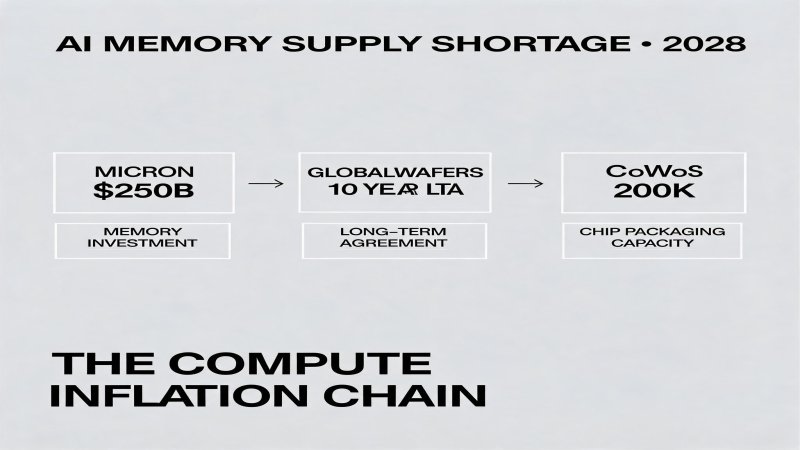
AI Memory Supply Shortage to 2028: The "Compute Inflation Chain" of Micron $250B + GlobalWafers 10-Year LTA + CoWoS 200K
1. Event Recap
Within the 72-hour window from July 9 to July 12, 2026, the global AI infrastructure supply chain released a cluster of mutually validating high-intensity signals. Micron announced an increase in its U.S. domestic investment scale from $200 billion to over $250 billion, provided $500 million in strategic financing to GlobalWafers to support its Texas Sherman 300mm wafer fab, and simultaneously signed a 10-year Long-Term Agreement (LTA) with GlobalWafers. [Verified: Micron Investor Relations official announcement] The Micron Q3 financial report disclosed the same day showed quarterly revenue of $41.46 billion (up 346% year-over-year), adjusted gross margin of 84.6%, HBM capacity sold out for 2026/2027 with customer orders booked through 2028, and 16 Strategic Customer Agreements (SCA) totaling $100 billion in locked-in orders (including $18 billion in non-cancellable prepayments). This series of numbers directly echoed the judgment in JPMorgan's 2Q26 semiconductor preview report: AI memory supply tightness will continue until 2028. [Verified: JPMorgan report/Living Portfolio]
On the upstream wafer side, TSMC's sub-7nm price increase of 8-12% took effect on July 1, and the average delivery cycle for AI/HPC chips was extended to 26 weeks (7 weeks longer than Q1). [Verified: DIGITIMES/Caixin] On the midstream packaging side, TSMC's CoWoS monthly capacity guidance was raised from the original 120,000 wafers per month (wpm) to 140,000 wpm by end of 2026 and 190,000-200,000 wpm in 2027, with supporting 3nm capacity increasing from 170,000 in 2026 to 200,000 in 2027, and 2nm from 90,000 in 2026 to 150,000 in 2027 to 200,000 in 2028. [Verified: DIGITIMES/Mizuho June 30 report]
On the downstream demand side, JPMorgan forecast that U.S. Top 4 Hyperscaler data center Capex will grow +80% year-over-year in 2026, and at least +50% in 2027, with ASIC/XPU share of the AI accelerator market rising from 32% in 2025 to 42% in 2026 to 53% in 2027. [Verified] SK Hynix completed a $28 billion Nasdaq IPO on July 10, with inventory at only about 4 weeks. [Verified: HiTech/SEC]
These signals together constitute the "AI Compute Inflation Chain"—the synchronous price increases of upstream materials (silicon wafer +99.48% year-to-date), midstream wafers (TSMC +8-12%), and downstream HBM/DDR5 (Q1 +90-95% / Q2 +58-63%) will be transmitted to the TCO curves of 2026H2-2027 new products such as NVIDIA Blackwell/Rubin, AMD MI400, Meta Iris, Google TPU, and AWS Trainium 4, ultimately affecting Hyperscalers.
The core narrative of the event can be summarized as three "endings": First, the end of the traditional "memory boom-bust" cycle narrative—the silicon-based commodity logic of 34 instances of 30%+ drawdowns over 42 years is structurally rewritten by 16 non-cancellable LTAs; Second, the short-term "AI compute oversupply" narrative is falsified by hard data showing HBM sold out through 2028; Third, the concrete implementation of the "Made in America" policy narrative—Micron's $250B + GlobalWafers LTA constitutes the largest and most systematic domestic memory ecosystem investment under the CHIPS Act framework.
This article will analyze the transmission mechanism of the "AI Compute Inflation Chain", the key beneficiaries and parties under pressure, and the judgment of breakthrough points from 2026 to 2028 from three dimensions: technical depth, financial logic, and strategic depth.
2. Technical Deep Dive
2.1 HBM Technical Structure and the Memory Wall Problem in AI Compute
HBM (High Bandwidth Memory) uses TSV (Through-Silicon Via) + micro-bump stacking processes to vertically stack multiple DRAM dies, which are then connected to the GPU/CPU/ASIC package substrate through a silicon interposer, providing bandwidth far exceeding traditional DDR. HBM4 is the latest generation of current JEDEC standardization, with single-die capacity of 24Gb (12Gb×2 stack or 24Gb×1 stack) and single-stack capacity of 36GB (12-Hi) or 48GB (16-Hi).
HBM plays a core role in AI compute as the breakthrough for the "memory wall". The NVIDIA Blackwell B200 HBM3e configuration is 192GB (8 stack × 24GB), providing 8TB/s of HBM bandwidth; the AMD MI355X is configured with 288GB HBM3e (12 stack × 24GB), with 6TB/s of bandwidth. The next-generation NVIDIA Rubin (expected 2026Q4) will further increase to 288GB or higher.
This means HBM capacity is directly linked to AI model scale. A GPT-4 level model has approximately 1.8T parameters under FP16 inference precision, requiring approximately 3.6TB of HBM (estimated by FP16 weights of 2 bytes + KV cache), or about 15-20 B200 GPUs; if it is GPT-5 or a larger model, a single inference requires 30-50 B200/Rubin GPUs. This fundamentally determines the "non-linear amplification" characteristic of AI compute expansion's demand for HBM.
2.2 Multi-Source Cross-Validation of Memory Supply Tightness
JPMorgan's 2Q26 semiconductor preview report (released July 10, 2026) confirmed that AI memory supply tightness will continue until 2028. This judgment received multi-source cross-validation:
| Source | Key Judgment | Time | Verification Level |
|---|---|---|---|
| JPMorgan | Memory supply tight through 2028 | 2026-07-10 | Verified |
| IDC | Memory supply tight until early 2028 | 2026-07 | High confidence |
| Intel CEO Pat Gelsinger | Memory supply no relief before 2028 | 2026-06 | High confidence |
| SK Hynix Announcement | All customer demand in 2026 cannot be met | 2026-07-10 | Verified |
| Gartner Gaurav Gupta | Chipflation will last 18-24 months (to 2028H1) | 2026-07 | Verified |
| Micron Q3 Report | HBM sold out through 2028, 16 SCA locking $100B | 2026-07-09 | Verified |
2.3 Four-Vendor HBM/DRAM Competitive Comparison Matrix
The current AI memory market has Micron, Samsung, and SK Hynix in a tripartite balance (on the DRAM side), with TSMC as the de facto monopolist for advanced packaging (CoWoS). Four-party comparison:
| Dimension | Micron | Samsung | SK Hynix | TSMC (CoWoS) |
|---|---|---|---|---|
| HBM Market Share (2026Q2) | ~24% | ~20% | ~52% | N/A (Packaging) |
| HBM4 Progress | 2026H2 mass production (designed into Vera Rubin) | 2026Q4 sample (delayed by technical issues) | 2026H2 mass production (leading) | N/A |
| U.S. Domestic Capacity | $250B by 2035, 40% target | Texas Taylor $17B+ plant under construction | None (Korea + Wuxi) | Arizona $165B |
| LTA Lock-in Scale | 16 SCA, totaling $100B locked | Undisclosed, Apple as core customer | NVIDIA + Hynix family customers | GPU+CPU+ASIC 200K wpm |
| Customer Structure | NVIDIA Vera Rubin, broad coverage | Apple (strong bargaining), Anthropic | NVIDIA largest, Anthropic | NVIDIA+AMD+MediaTek+Broadcom |
| Key Differentiation | Only U.S. domestic DRAM+HBM full stack | Only non-U.S.+Korea dual location | HBM3e first-mover + technology leading | 70% of global advanced CoWoS capacity |
| 2026 Stock Performance | +35% (YTD, from $755 to $1,020) | +12% (YTD, memory+consumer split) | July 10 Nasdaq $28B IPO | +28% (YTD, AI foundry monopoly) |
| 2026Q2-Q3 Key Events | 7-9 announcement $250B + GlobalWafers LTA | HBM profit up, consumer device profit down | $28B IPO, 4 weeks inventory | CoWoS 200K wpm 2027 guidance |
2.4 CoWoS Packaging Bottleneck: From 20% Gap to 10% Convergence
CoWoS (Chip-on-Wafer-on-Substrate) is TSMC's 2.5D advanced packaging technology that connects HBM stacks with logic die side-by-side through a silicon interposer. Mizuho's June 30 report raised TSMC's CoWoS capacity guidance:
| Time Point | TSMC CoWoS (wpm) | Third-Party OSAT Supplement (wpm) | Global Advanced CoWoS TSMC Share |
|---|---|---|---|
| End of 2025 | ~120,000 | ASE ~10,000 | 92% |
| End of 2026 | 140,000 (original 120,000) | ASE 20,000 | 87% |
| 2027 | 190,000-200,000 (original 170-180K) | ASE 40-45K + Amkor 20-25K | 80% |
- NVIDIA 2026: 630,000 wafer → 2027: 1,005,000 wafer (Blackwell GPU + Vera server CPU first large-scale use of CoWoS-R)
- MediaTek 2027: 180,000 wafer (original 93,000, nearly doubled)—ARM architecture AI server CPU volume
- Broadcom: 425,000 wafer (Google TPU demand growth slowdown hedge)
In 2027, total global CoWoS demand is 2,694,000 wafers, with server CPU-related packaging share rising from 11% in 2025 to 24% in 2027. This means CoWoS has been upgraded from "NVIDIA GPU exclusive support" to "GPU+AI server CPU+custom ASIC" jointly driven long-cycle track, with 3+ years of sustained high growth.
2.5 Upstream-Downstream Transmission: Wafer → HBM → CoWoS → AI Chip → AI Service Complete Chain
The "AI Compute Inflation Chain" is a 5-layer cost transmission structure:
| Layer | Representative | 2026 Price Increase | Duration | Main Driver |
|---|---|---|---|---|
| L1 Wafer Manufacturing | 12-inch silicon wafer (GlobalWafers) | +10-15% (Lion Micro 2nd round in June) | Through 2027 | AI + wafer fab expansion |
| L1 Wafer Manufacturing | TSMC sub-7nm wafer | +8-12% (effective July 1) | Continuous | EUV bottleneck + yield |
| L2 HBM/DRAM | HBM4 | $2→$4-5/Gb | 2026H2-2027 double | AI server 8-10x demand |
| L2 HBM/DRAM | Server DDR5 | Q1+90-95%, Q2+58-63% | Through 2028 | 70% capacity to HBM |
| L2 HBM/DRAM | NAND | Q1+55-60%, Q2+70-75% | Through 2027 | Consumer electronics squeeze |
| L3 Advanced Packaging | TSMC CoWoS | Capacity +67% (2026) → 200K (2027) | Continuous | Supply-demand gap 20%→10% |
| L3 Advanced Packaging | China OSAT (JCET) | capex $1.4B | 2026-2027 | Domestic substitution |
| L4 Finished Chip | NVIDIA Blackwell/Rubin | +5-15% | 2026H2 | Upstream cost transmission |
| L4 Finished Chip | Custom ASIC (Meta/Google/AWS) | TCO advantage | Continuous | Internal digestion |
| L5 AI Service | Hyperscaler AI compute rental | +20-30% | Continuous | "Compute is capital" |
3. Financial Logic
3.1 Financial Sustainability of Micron's $250B Investment Scale
Micron's increase in U.S. domestic investment scale from $200B to $250B+ (through 2035) is one of the largest single corporate investment commitments under the CHIPS Act framework. Structurally:
- Clay, NY plant: First concrete pour, one quarter ahead of schedule
- Boise, Idaho: HBM advanced packaging expansion
- Simultaneous LTA with GlobalWafers locking 300mm silicon wafer
Funding sources: CHIPS Act direct subsidies ($6.1B) + Investment Tax Credit (25%) + Customer prepayments ($18B non-cancellable) + Free cash flow (Q3 gross margin of 84.6% support).
Financial sustainability analysis: Micron's Q3 revenue of $41.46B and adjusted gross margin of 84.6%—this gross margin level is close to NVIDIA's data center business (75%), significantly higher than any memory manufacturer in history. This means memory is no longer a "cyclical commodity" but "quasi-subscription revenue".
3.2 Financial Engineering Significance of 16 Strategic Customer Agreements
Micron disclosed 16 SCAs totaling $100B in locked-in orders, including $18B in non-cancellable prepayments. This scale is equivalent to 2.4 times Micron's Q3 quarterly revenue—it has triple financial engineering significance:
- Revenue visibility: Extends the traditional memory "order-shipment-revenue" 3-6 month cycle to "3-5 year lock-in". This is similar to SaaS subscription models.
- Cash flow front-loading: $18B non-cancellable prepayments are nearly 3 times 2024 free cash flow, providing expansion capital.
- Risk sharing: Customer prepayments mean customers share capacity expansion risk. If AI demand is lower than expected, prepayments are usually non-refundable ("take-or-pay" terms).
This structure is unprecedented in the traditional memory industry—34 instances of 30%+ drawdowns over 42 years of history all stemmed from "spot market + order volatility" transmission chain. LTA structurally eliminates the "spot market", rewriting the memory cycle from "commodity cycle" to "quasi-infrastructure cycle".
3.3 SK Hynix $28B IPO and AI Memory Financing Wave
SK Hynix's $28B Nasdaq IPO on July 10 is the largest tech IPO of 2026 to date. Use of proceeds is primarily for:
- Korea Cheongju M15X plant HBM expansion
- U.S. Indiana West Lafayette HBM advanced packaging plant (paired with TSMC Arizona plant)
- R&D investment: HBM5 development + 1c/1y DRAM technology node
The capital market's strong demand for SK Hynix's IPO (limited discount, up on listing day) confirms the "AI memory long-term demand" judgment. Samsung's 2Q26 financial report shows a "split landscape"—HBM profit up, consumer device profit down, highlighting that "AI memory vs consumer memory" in Samsung's internal business is already two different business logics.
3.4 NVIDIA Q2 FY2027 Report: "Official Endorsement" of AI Compute Inflation
NVIDIA's July 12 Q2 FY2027 financial report (2026-07-12 DailyShift signal #1) data:
- Revenue $35.1B (vs $33.2B expected, +5.7% upside)
- Data center $30.8B (+112% YoY)
- Q3 guidance $37.5B (above market expectations)
- Adjusted gross margin approximately 75%
[Verified: WSJ/NVDA Q2 FY2027 after-hours]
Data center +112% YoY + gross margin 75% = "AI compute demand + pricing power" double confirmation. Q3 guidance of $37.5B implies annualized revenue of $150B+, 2.5 times FY2024 ($60.9B). Q2 5.7% upside vs the "AI compute oversupply" concerns that had emerged in Q1 forms a sharp contrast—NVIDIA falsified the "AI bubble" short-term narrative with actual performance.
3.5 Macroeconomic Transmission of Chipflation: From BOM to CPI
Gartner forecasts chipflation will continue through 2028H1: PC prices +17.3% full-year, smartphones +13%. 2026 smartphone shipments -11%, PC shipments -9%.
| Product | 2026Q1 Increase | 2026Q2 Increase | 2026Q3 Forecast |
|---|---|---|---|
| DRAM contract price | +90-95% | +58-63% | +13-18% |
| NAND contract price | +55-60% | +70-75% | +10-15% |
| 16GB DDR5 (retail) | ¥450→¥1,800 (+300%) | - | - |
| 32GB DDR5 (retail) | ¥900→¥3,800 (+320%) | - | - |
| HBM4 (unit price/Gb) | $2 (2026H2) | - | $4-5 (2027) |
4. Strategic Depth
4.1 Beneficiaries vs. Parties Under Pressure of the Inflation Chain
Beneficiaries (ranked by 2026-2027 marginal returns):
- TSMC (market cap $1.2T+): 8-12% wafer price increase + CoWoS 200K wpm 2027 + Arizona $165B
- Micron (market cap $1,020+): 16 SCA + GlobalWafers LTA + $250B U.S. expansion
- SK Hynix: HBM technology leading + $28B IPO financing + India packaging plant
- Samsung: HBM profit up, but consumer device business under pressure
- GlobalWafers: Only U.S. domestic 300mm + 10-year LTA + CHIPS Act strategic position
- ASML: EUV equipment delivery 12-18 months + 2026 equipment spending +28%, 2027 +29%
- Broadcom: Custom ASIC (Google TPU / Meta MTIA) + FY27 AI revenue $100B+
- Coherent / Lumentum / Sumitomo Electric: Optical interconnect demand structurally rising
Parties Under Pressure:
- AI OEM (HPE / Dell / Supermicro): BOM cost up 5-15%, gross margin compressed
- Android phone makers: Weaker bargaining power than Apple, market share declining
- PC makers (HP / Lenovo / Acer): Gartner forecasts -9% shipments
- China foundries (SMIC / Hua Hong): Dual pressure of price increase + U.S. export controls
- Memory secondary market / spot market: Supply tight through 2027, arbitrage space disappears
- Small Hyperscalers / independent AI companies: Compute procurement cost up 20-30%, pushed out of mainstream model training threshold
4.2 Hyperscaler "Compute is Capital" Strategy and Custom ASIC Window Period
JPMorgan forecasts U.S. Top 4 Hyperscaler 2026 Capex +80% YoY, 2027 at least +50% more. This means:
- AWS 2026 Capex ~$120B (vs 2025 $80B)
- Microsoft 2026 Capex ~$100B (vs 2025 $75B)
- Google 2026 Capex ~$110B (vs 2025 $75B)
- Meta 2026 Capex ~$80B (vs 2025 $60B)
Totaling ~$410B, 1.4 times 2025 ($290B). One of the core Capex destinations is custom ASIC: Meta MTIA four-generation roadmap, Google TPU v6/v7, AWS Trainium 4, Microsoft Maia 100.
The core logic of ASIC strategy is "internal digestion of chipflation"—vertical integration of in-house chips + in-house wafer fabs + in-house packaging to hedge the price risk of purchasing NVIDIA/AMD. But the TCO advantage of ASIC is most obvious in the 2026H2-2027H1 window period: CoWoS 200K wpm 2027 capacity release + custom ASIC design maturity, ASIC single-card TCO may be 15-25% lower than purchased NVIDIA.
But this window period is also the critical defense period for NVIDIA Blackwell/Rubin—NVIDIA through "Blackwell Ultra (2026H2) + Rubin (2027H1) + Feynman (2028H2-2029)" rapid iteration, with NVLink Switch 6/7, BlueField-3 DPU, CUDA ecosystem binding, locking Hyperscalers' existing compute.
4.3 China's "Domestic Substitution" Window and Global Supply Chain Bipolarization
The impact of the AI memory inflation chain on the Chinese market is "bidirectional pressure":
Upward squeeze: Chinese foundries (SMIC/Hua Hong/CXMT) face dual pressure of "being raised + being U.S. export controlled".
- ASML EUV equipment not exported to China (extended to DUV immersion ArF)
- TSMC price increase applies equally to Chinese customers
- Micron/SK Hynix/Samsung HBM/LPDDR high-end products limited to Chinese phone makers
Downward squeeze: Window for domestic substitution opens.
- CXMT DDR5 mass production ramp-up, HBM3 in development
- YMTC NAND 232-layer mass production
- Lion Micro / Youyan Silicon / Shengong Shares / NSIG: 12-inch silicon wafer domestic substitution rate from 15-20% to 25-30%
- JCET (JCET) $1.4B capex to advanced packaging
- SMIC/Hua Hong: 28nm/14nm FinFET mature process expansion
But we need to soberly recognize the gap: On HBM, CXMT has a 2-3 generation gap from SK Hynix (HBM3 vs HBM4); On advanced packaging, JCET's CoWoS-equivalent technology is significantly behind TSMC's CoWoS-S; On EUV lithography, China is still in the critical stage of tackling.
This means China's "domestic substitution" can advance in mature processes, consumer electronics, special applications, etc., but the gap in the main AI compute battlefield (HBM+CoWoS+EUV) is difficult to bridge in the short term.
4.4 Semiconductor Geopolitics: The Embryonic Form of CHIPS Act 2.0
Micron $250B + GlobalWafers LTA is the largest and most systematic domestic memory ecosystem investment under the CHIPS Act framework. This, together with the public support statements from Commerce Secretary Howard Lutnick and USTR Jamieson Greer on July 9, constitutes a policy signal of "American memory independence".
Possible CHIPS Act 2.0 directions:
- HBM domestic subsidies: Micron Boise + West Lafayette expansion support
- Advanced packaging national strategy: U.S. domestic R&D of CoWoS-equivalent technology (paired with TSMC Arizona plant)
- Key materials list: Silicon wafer (GlobalWafers) / photoresist / electronic specialty gas / CMP slurry
- Tax treatment of customer prepayments: Encourage Hyperscalers to prepay U.S. domestic memory plants
- "Non-U.S.+Korea dual location" requirement for Samsung/SK Hynix: In exchange for Chinese market access
If this framework takes shape, it will have a structural impact on the global AI memory supply chain—the "U.S. domestic + allies" second-tier supply chain, and the "China domestic + third-party" third-tier supply chain, may form a long-term coexisting bipolar pattern.
4.5 Connection with 2026-07-12 NVIDIA $5T Market Cap + Apple v. OpenAI Lawsuit
This round of "AI Compute Inflation Chain" event forms a complete narrative closed loop with multiple signals on 2026-07-12:
| 2026-07-12 Reported Signal | Connection with Inflation Chain |
|---|---|
| Apple 41-page complaint against OpenAI | AI hardware talent war → antitrust + trade secret protection cost rising |
| NVIDIA market cap $5.02T | AI compute demand hard constraint → strongest signal of inflation chain |
| Anthropic 3.5GW TPU | Hyperscaler custom ASIC → anti-NVIDIA pricing power |
| Meta Iris September mass production | Custom ASIC window period → same as above |
| Microsoft takes over OpenAI abandoned Arctic | Hyperscaler Capex priority adjustment |
| TSMC+ASML+Imec 2D chips | Moore's law life extension → long-term supply-side "breakthrough point" |
- Increase Capex (short-term)
- Custom ASIC (medium-term)
- Lock LTA (long-term)
- Invest in upstream materials/packaging (defensive)
4.6 Paradigm Significance of AI Memory "Quasi-Infrastructure-ization"
From a more macro perspective, the transformation of AI memory from "commodity" to "quasi-infrastructure" is an inevitable result of AI compute becoming a "water, electricity, coal" level factor of production. When AI models become the next-generation software infrastructure, the HBM/DDR5/SSD required for their training and inference also becomes the "oil of the AI era".
The implications of this paradigm shift are profound:
- Pricing model: From "spot market + short-term contracts" to "long-term LTA + prepayments"—similar to the electricity market's PPA (Power Purchase Agreement)
- Financial attributes: From "cyclical stocks" to "growth stocks + defensive stocks" dual attributes
- Geopolitical attributes: From "global free trade commodities" to "strategic materials"
- Technical attributes: From "standardized products" to "customized solutions" (HBM stack customized per ASIC needs)
5. Challenges and Concerns
5.1 "Demand Cliff" Risk
The biggest concern of the AI memory inflation chain is the "demand cliff"—if Hyperscaler Capex slows in 2027H1, a "double-dip" similar to the 2008-2009 DRAM industry may occur.
JPMorgan and IDC's optimistic judgment on 2027-2028 AI memory demand is mainly based on:
- ASIC/XPU share of AI accelerator market rising from 32% in 2025 to 53% in 2027
- TSMC Capex: $58B in 2026, $78B in 2027, $84B in 2028 (revised up again)
- NVIDIA $1 trillion order pipeline + Broadcom FY27 AI revenue $100B+ dual-line demand confirmation
[Verified: JPMorgan 2Q26 preview]
But potential risk points:
- AI Capex ROI issue: AI Capex's ROI is still unclear. Although Anthropic and OpenAI's revenue growth is fast (CAGR 200%+), relative to the $410B/year Capex magnitude, the payback period may be 5-10 years. If AI commercialization progresses below expectations, Hyperscalers may see Capex slowdown in 2027H1-2028H1.
- "AI bubble" second shock: Two "AI bubble theory"-led tech stock corrections have already occurred in May 2025 and May 2026. If a third one occurs, it may form a short-term price shock to AI memory.
- Macroeconomic recession: Chipflation transmits to CPI (PC +17.3%, phone +13%), which may trigger further contraction in consumer electronics demand, in turn affecting the non-HBM part of DRAM/NAND.
5.2 China Market "Dual-Track" Risk
As the only manufacturer in the U.S. CHIPS Act that can produce 300mm advanced wafers on U.S. domestic soil, GlobalWafers' LTA binding to Micron means Chinese memory manufacturers (CXMT/YMTC) face "upstream silicon wafer lock-in" risk.
Specific path:
- CXMT DDR5 mass production requires stable 300mm silicon wafer supply
- Global high-end silicon wafer suppliers: Shin-Etsu (Japan) / SUMCO (Japan) / GlobalWafers (Taiwan, China, GlobalWafers parent) / Siltronic (Germany, already acquired by GlobalWafers)
- 70%+ capacity of GlobalWafers/Shin-Etsu/SUMCO has been locked by Micron/SK Hynix etc.
- China mainland 12-inch silicon wafer monthly capacity to reach 1/3 of global in 2026 (SEMI forecast), but capacity is concentrated in second-tier suppliers such as Lion Micro/Youyan Silicon/NSIG
In the short term, the Chinese memory industry chain may face a "triangular constraint" of "upstream material lock-in + midstream mature process price advantage + downstream HPC demand".
5.3 SK Hynix's Technology Leading Window Period
SK Hynix currently has 52% HBM market share, and its HBM3e technology leads Samsung and Micron by about 6-9 months. But this window period is not permanent:
- Samsung HBM4 expected 2026Q4 sample (delayed by technical issues), 2027H1 mass production
- Micron HBM4 2026H2 mass production, designed into NVIDIA Vera Rubin
- SK Hynix HBM4 2026H2 mass production
After 2027H2, the time difference in HBM4 mass production among the three will narrow to 3-6 months. SK Hynix needs to consolidate its leading edge by accelerating HBM4/HBM5 R&D + India/U.S. packaging plant construction through $28B IPO financing.
5.4 Vicious Cycle in Consumer PC/Phone Market
The impact of chipflation on PC and phones has already emerged:
- 2026 smartphone shipments -11% (Gartner)
- 2026 PC shipments -9% (Gartner)
- 16GB DDR5 soared from ¥450 to ¥1,800 (+300%)
This "high price low volume" combination may form a vicious cycle: consumers postpone purchases → OEMs cut orders → memory makers shift more capacity to HBM → consumer electronics memory supply further tightens → prices continue to rise.
The breakthrough point may be: consumer electronics makers adopt "AI PC/AI Phone" new forms, increase single device ASP (average selling price), and pass chipflation costs to end users. Starting from 2026H2, the new product releases of AI PC (Copilot+ / Apple Intelligence) and AI phones (on-device large models) will be the key observation point.
5.5 Backlash of U.S. Export Controls on Global AI Memory Supply Chain
U.S. memory export controls on China continue to escalate:
- Micron/SK Hynix/Samsung HBM/LPDDR high-end products restricted to Chinese phone makers
- ASML EUV/DUV immersion ArF export controls to China
- NAURA/AMEC and other Chinese equipment makers on entity list
But export controls have backlash effects:
- China market accounts for about 35% of global DRAM demand, 30% of NAND
- Restricting exports means accelerating China's "domestic substitution", unfavorable to U.S./Korean memory makers in the long run
- The "gray area" of HBM/LPDDR controls (HPC use vs consumer electronics use) is difficult to precisely define
5.6 "Reverse Lock-In" Risk of Hyperscaler Custom ASIC
Although Hyperscaler custom ASIC (Meta MTIA / Google TPU / AWS Trainium / Microsoft Maia) can internally digest chipflation, it also brings new risks:
- ASIC R&D cycle is long (3-5 years), if design fails, opportunity cost is huge
- ASIC ecosystem binding (CUDA vs ROCm vs TPU XLA vs Trainium Neuron SDK) leads to rising software costs
- ASIC capacity depends on TSMC, sharing the same production line as NVIDIA—capacity allocation conflicts
The "diversion effect" of Google TPU has already shown—Broadcom's 2027 CoWoS orders have been slightly reduced to 425,000 wafers, because of Google TPU demand growth slowdown. The "excessive concentration" risk of Hyperscaler custom ASIC needs observation.
6. Conclusion
6.1 Core Judgment
The "AI Compute Inflation Chain" event from July 9-13, 2026 (Micron $250B + GlobalWafers 10-year LTA + CoWoS 200K + TSMC 8-12% price increase + HBM sold out through 2028) is a landmark event in the paradigm transformation of AI infrastructure from "commodity" to "quasi-infrastructure".
Core arguments:
- AI memory from "commodity" to "quasi-infrastructure": 16 non-cancellable SCA + $100B lock-in + $18B prepayment = 3-5 year financial visibility from nothing
- Inflation chain is 5-layer transmission: silicon wafer → HBM/DDR5 → CoWoS → AI chip → AI service
- Beneficiaries/parties under pressure bipolarization: TSMC/Micron/SK Hynix/GlobalWafers vs AI OEM/Android phones/PC makers/China foundries
- 2026-2028 breakthrough points: CoWoS 200K wpm 2027 + HBM5 2028 + TSMC N2 2027 200K wpm
- China "domestic substitution" window period: Mature processes + consumer electronics + special applications can advance, HBM+CoWoS+EUV gap remains large
6.2 Timeline Predictions
| Time | Key Event | Inflation Chain Impact |
|---|---|---|
| 2026Q3 | TSMC Q2 financial report (7-16) + ASML Q2 financial report (7-15) | Verify price increase transmission + capex guidance |
| 2026Q4 | NVIDIA Blackwell Ultra release | Inflation chain transmits to end market |
| 2027H1 | SK Hynix India HBM packaging plant + Micron Boise expansion | HBM4 supply increases |
| 2027H2 | TSMC CoWoS 200K wpm + HBM5 sample | Supply-demand gap further converges |
| 2028H1 | Chipflation peaks then gradually eases (Gartner) | Consumer electronics demand recovery |
| 2028H2 | HBM5 mass production + TSMC 2nm 200K wpm | New supply-demand balance |
6.3 Manufacturer/Investor/Policy Recommendations
For memory makers (Micron/SK Hynix/Samsung):
- Accelerate HBM4/HBM5 R&D + U.S./European domestic capacity construction
- Lock more LTA customers (in addition to NVIDIA, AMD/AWS/Google/Meta, etc.)
- Plan ahead for HBM5 16-Hi/20-Hi TSV + micro-bump process
For Hyperscalers (AWS/Microsoft/Google/Meta):
- Accelerate custom ASIC (MTIA/TPU/Trainium/Maia) to hedge chipflation
- Expand LTA lock-in scale, transform memory from "procurement" to "strategic partnership"
- Invest in upstream materials/packaging (photoresist, electronic specialty gas, CoWoS-equivalent technology)
- Accept 5-10 year payback period for AI Capex ROI
For AI OEM (HPE/Dell/Supermicro):
- Sign multi-year LTA with memory makers to hedge BOM costs
- Increase AI server ASP, pass chipflation to customers
- Explore "compute subscription" model, similar to SaaS
For China foundries/equipment makers:
- Accelerate 28nm/14nm FinFET mature process expansion
- Increase R&D investment in CoWoS-equivalent technology
- Consolidate mature DRAM/NAND independent supply chain
For investors:
- AI memory "quasi-infrastructure-ization" is a 3-5 year long-cycle narrative, not a short-term cycle
- Focus on "full-stack AI memory" targets (Micron > Samsung > SK Hynix, TSMC is the hidden monopolist)
- Note "demand cliff" risk: 2027H1 Hyperscaler Capex slowdown is the biggest variable
- China memory/packaging/equipment targets as "domestic substitution" theme, watch for policy catalysts
For policymakers:
- U.S.: CHIPS Act 2.0 focuses on HBM domestic + advanced packaging national strategy
- EU: European memory industrial policy (refer to GlobalWafers acquisition of Siltronic)
- China: Mature processes + special applications as short-term focus, HBM+CoWoS+EUV as long-term attack
6.4 Ultimate Judgment
The "AI Compute Inflation Chain" is the third macro narrative in the AI era following "compute oversupply" and "AI bubble", and the one closest to "hard constraints". When HBM sold out through 2028, TSMC 8-12% price increase, CoWoS 200K wpm 2027, Micron $250B + GlobalWafers 10-year LTA these hard data come together, AI compute expansion is no longer driven by demand alone, but constrained structurally by the entire industry chain of "upstream materials-midstream wafers-downstream packaging".
The impact of this constraint on the AI industry is two-sided: in the short term, it puts pressure on Hyperscalers' BOM costs, forcing the acceleration of custom ASIC; in the long term, it will elevate AI memory from "commodity" to "quasi-infrastructure", reshaping the geopolitical pattern of the global semiconductor supply chain.
The most critical judgment is: The "quasi-infrastructure-ization" of AI memory will continue until after the chipflation peak in 2028H1, and the new supply-demand balance of HBM5+CoWoS 200K wpm forms in 2028H2, the "AI Compute Inflation Chain" may enter a new steady state. Before that, every minor adjustment of Hyperscaler Capex, every breakthrough in AI model architecture, every geopolitical conflict, may amplify transmission in the inflation chain.
For the entire AI industry, understanding the transmission mechanism of the "AI Compute Inflation Chain", identifying beneficiaries and parties under pressure, and judging the breakthrough points from 2026 to 2028, is the most important strategic topic for the next 18-24 months.
Why it Matters
This event marks the paradigm transformation of AI infrastructure from commodity to quasi-infrastructure. At the legal level, 16 non-cancellable SCA + 10-year LTA rewrite the traditional memory cycle narrative of 34 instances of 30%+ drawdowns over 42 years, with memory cycle quasi-infrastructure-ized; At the industry level, the 5-layer transmission of the AI compute inflation chain (silicon wafer + HBM + CoWoS + AI chip + AI service) pushes Hyperscaler BOM costs up 5-15%, forcing acceleration of custom ASIC (Meta MTIA/Google TPU/AWS Trainium 4/Microsoft Maia 100); At the geopolitical level, the embryonic form of CHIPS Act 2.0 (U.S. memory independence) + China's domestic substitution window period (mature processes can advance + HBM gap remains large) form a bipolar pattern of the global AI supply chain. Investors need to reassess the 5-10 year payback period for AI Capex ROI.
DECISION
- Hyperscaler (CTO/CIO): Accelerate custom ASIC (MTIA/TPU/Trainium/Maia) to hedge chipflation; expand LTA lock-in scale to transform memory from procurement to strategic partnership; accept 5-10 year payback period for AI Capex ROI
- Memory makers (CFO/Strategy): Accelerate HBM4/HBM5 R&D + U.S./European domestic capacity construction; lock more LTA customers (in addition to NVIDIA, AMD/AWS/Google/Meta, etc.); plan ahead for HBM5 16-Hi/20-Hi TSV + micro-bump process
- AI OEM (Product/Supply Chain): Sign multi-year LTA with memory makers to hedge BOM costs; increase AI server ASP to pass chipflation to customers; explore compute subscription model (similar to SaaS)
- Investors (Portfolio Management): AI memory quasi-infrastructure-ization is a 3-5 year long-cycle narrative, not a short-term cycle; focus on full-stack AI memory targets (Micron > Samsung > SK Hynix, TSMC is the hidden monopolist); note the 2027H1 Hyperscaler Capex slowdown demand cliff risk
PREDICT
- Within 12 months (2026Q3-2027Q2): TSMC Q2 financial report (7-16) + ASML Q2 financial report (7-15) verify price increase transmission + capex guidance; NVIDIA Blackwell Ultra release (2026Q4) inflation chain transmits to end market; SK Hynix India HBM packaging plant + Micron Boise expansion HBM4 supply increases
- Within 24 months (2027H2-2028H1): TSMC CoWoS 200K wpm + HBM5 sample supply-demand gap further converges; Chipflation peak then gradually eases (Gartner forecast); consumer electronics demand recovers
- Within 36 months (2028H2-2030): HBM5 mass production + TSMC 2nm 200K wpm new supply-demand balance forms; AI memory quasi-infrastructure-ization narrative stabilizes; China's domestic substitution advances in mature processes + special applications, HBM+CoWoS+EUV remains long-term attack
- Medium to long term (2030+): CHIPS Act 2.0 takes shape (U.S. memory independence + advanced packaging national strategy); global AI supply chain bipolar pattern (U.S.+allies vs China+third party) stabilizes; AI Capex may shift from FOMO to ROI-driven
Get 3-5 key AI infrastructure signals weekly →
💬 Comments (0)