
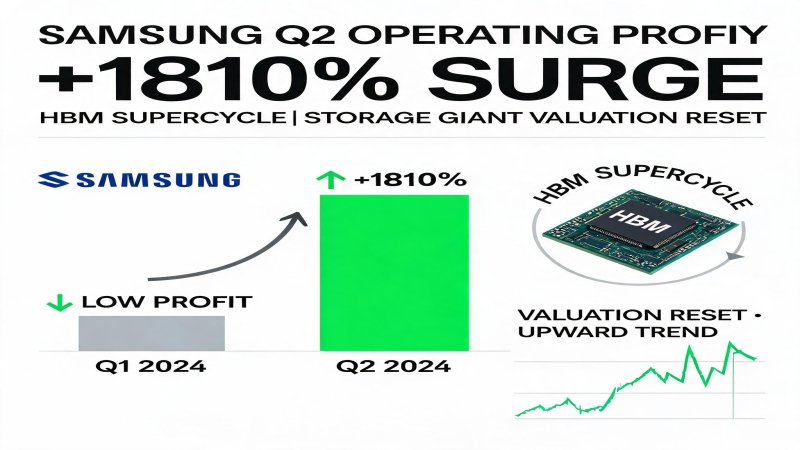
<h2>I. Event Recap: Samsung Electronics Q2 Earnings Shock the Market</h2><p>On July 8, 2026, Samsung Electronics released its Q2 2026 earnings guidance, stunning the tech investment world. Revenue reached approximately 171 trillion KRW (~$127 billion USD), up 129% year-over-year; operating profit hit 89.4 trillion KRW (~$66.4 billion USD), surging 1,810% YoY. This not only smashed consensus estimates of 84.6 trillion KRW but also surpassed NVIDIA's previous record for quarterly profit by any global technology company.</p><p>Reviewing the timeline, Samsung's earnings explosion was not without warning. Full-year 2025 operating profit was merely 43.6 trillion KRW, with memory chips at the bottom of the cycle. The turning point began in Q1 2026: revenue of 133.9 trillion KRW and operating profit of 57.2 trillion KRW already exceeded full-year 2025. In Q2, AI infrastructure investment accelerated, HBM supply fell short of demand, and rising memory ASPs expanded margins. First-half cumulative operating profit reached 146.6 trillion KRW, 3.4x the full-year 2025 total.</p><p>On July 3, Samsung Semiconductor chief Kim Yong-kwan signaled internally: "This year's profit will exceed the cumulative total of our 40 years in the semiconductor business." Samsung also plans a 90 trillion KRW stock buyback for employee bonuses—potentially the largest in Korean capital markets history.</p><h2>II. Technical Deep Dive: How HBM Became the Profit Engine</h2><p>The core technical driver is HBM (High Bandwidth Memory). Every NVIDIA GPU requires substantial HBM, and as HBM evolves from HBM3 to HBM4, per-chip capacity and bandwidth are doubling while supply expansion lags far behind demand.</p><p>Technically, HBM uses 3D stacking with TSVs (Through-Silicon Vias) connecting multiple DRAM layers vertically, then packaged with GPUs via micro-bumps. HBM4 is expected to stack 16 DRAM layers with 48GB capacity and over 2TB/s bandwidth. Samsung's core advantage is its "full-stack capability" as the world's largest DRAM maker with advanced packaging (TC-NCF) and one of the few suppliers offering both HBM3E and HBM4 samples.</p><p>Samsung's sixth-generation HBM sales exceeded $1.2 billion by end of June and continue climbing. Critically, Samsung is bundling HBM with its own logic chips (Exynos) and foundry services, creating an integrated "memory + logic + packaging" solution—contrasting sharply with SK Hynix's HBM-only focus and Micron's relative lag in HBM.</p><h2>III. Financial Logic: Does the Cyclical Valuation Anchor Still Hold?</h2><p>Samsung has long been viewed as a "cyclical stock" whose profits rise and fall with memory prices. But 2026 is breaking that framework.</p><p>Core metrics: Q2 revenue of 171 trillion KRW, operating profit of 89.4 trillion KRW, implying an operating margin of ~52.3%—rare in manufacturing. If full-year operating profit reaches the expected 300 trillion KRW (~$220 billion), net profit would approach $187 billion. At the current ~$1.29 trillion market cap, the forward P/E is under 7x.</p><p>By comparison: NVIDIA trades at ~23x, TSMC at ~18x, SK Hynix at ~12x. Samsung's valuation discount reflects both market inertia labeling it cyclical and concerns about its technology roadmap. But for a company with 18x quarterly profit growth in the AI infrastructure supercycle, a sub-7x P/E represents a significant gap.</p><p>Free cash flow is robust, supporting massive capex (over 40 trillion KRW annually) and the 90 trillion KRW buyback plan.</p><h2>IV. Strategic Depth: Samsung vs SK Hynix vs Micron Competitive Matrix</h2>
| Dimension | Samsung Electronics | SK Hynix | Micron |
|---|---|---|---|
| HBM Roadmap | HBM3E mass production, HBM4 samples, 16-layer | HBM3E lead production, NVIDIA main supplier | HBM3E early production, HBM4 R&D |
| Q2 2026 Profit Growth | +1,810% | Est. +800% | Est. +300% |
| Customer Base | NVIDIA, AMD, internal Exynos | NVIDIA (largest customer) | AMD, some cloud vendors |
| Capacity Footprint | Korea + China Xi'an + US Taylor | Korea Icheon + US Indiana | US + Japan + Singapore |
| Full-Stack Capability | Memory + Logic + Foundry + Packaging | Memory-focused | Memory-focused |
| Tech Differentiation | X-Cube 3D IC, TC-NCF | MR-MUF packaging | 1β process DRAM |
Why it Matters
Samsung is the only semiconductor giant with scaled presence in memory, foundry, and logic. Its Q2 results reflect not just HBM cycle strength but structural reshaping of memory by AI infrastructure investment. If full-year profit reaches 300 trillion KRW, the sub-7x P/E suggests the market may be significantly undervaluing Samsung's growth potential in the AI era.
DECISION
Investors: Current valuation offers attractive risk-reward; watch July 30 earnings and buyback progress. Enterprise procurement: Lock in long-term memory supply agreements; HBM3E procurement window is narrowing. Competitors: SK Hynix and Micron must accelerate HBM4 R&D or risk further falling behind in the next technology iteration.
PREDICT
1) Full-year 2026 operating profit expected to reach 300 trillion KRW, with forward P/E expanding to 10-12x. 2) HBM4 volume ramps in H1 2027, narrowing Samsung-SK Hynix market share gap to within 5 percentage points. 3) 90 trillion KRW buyback, if executed, could drive 15-20% stock appreciation. 4) Memory supply-demand tension continues through 2027, but growth moderates from explosive 2026 levels to high-stability.
Get 3-5 key AI infrastructure signals weekly →
💬 Comments (0)