
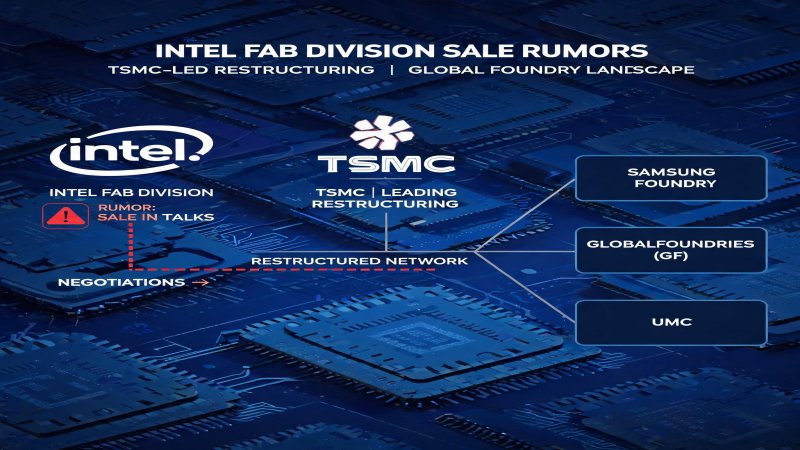
I. Event Recap
On July 12, 2026, Reuters reported that TSMC proposed forming a joint venture to take over Intel's chip manufacturing division (Intel Foundry Services). TSMC reportedly approached NVIDIA, AMD, Broadcom, and Qualcomm about participating. The Trump administration allegedly favors the deal but requires TSMC's stake not exceed 50% to maintain formal U.S. ownership. NVIDIA and Broadcom are reportedly testing chips on Intel's 18A process, while AMD is evaluating it. Intel's board reportedly prefers selling manufacturing and design divisions (Core and Xeon processors) as a package, complicating negotiations. Broadcom CEO Hock Tan previously ruled out a direct acquisition under his management. Intel shares initially surged 10% on the report before falling approximately 5% amid market uncertainty, closing at $109.84 with a 5.01% intraday swing.
二、技术纵深
这场潜在交易的技术核心是
Intel 18A工艺
——这是Intel在先进制程竞赛中的最新赌注,也是其向外部客户开放代工服务的技术基石。
Intel 18A工艺(1.8nm级)技术参数
:
晶体管密度
:约2.0亿晶体管/平方毫米(与TSMC N2相当)
全环绕栅极(GAA)晶体管
:采用RibbonFET技术,首次在Intel工艺中引入GAA结构
背面供电(PowerVia)
:将电源线移至晶圆背面,减少正面布线拥堵,提升性能10-15%
EUV层数
:预计超过20层,依赖ASML High-NA EUV设备
目标量产时间
:2025年底开始风险生产,2026年大规模量产
NVIDIA和Broadcom正在测试18A工艺的消息意义重大。这两家公司是台积电最大的客户之一——NVIDIA的AI GPU(Blackwell、Rubin系列)和Broadcom的定制AI芯片(为Google、Meta等设计)都依赖最先进的制程。如果它们将部分产能转移到Intel 18A,意味着对TSMC垄断地位的实质性挑战。
先进制程竞争对比矩阵
工艺节点
Intel
TSMC
Samsung
3nm级
Intel 3(2024量产)
N3(2022量产)/ N3E(2023)
SF3(2024)
2nm级
Intel 18A(2026量产)
N2(2025量产)
SF2(2025试产)
GAA晶体管
RibbonFET(18A首次)
Nanosheet(N2首次)
GAA(SF3首次)
背面供电
PowerVia(18A首次商用)
Super Power Rail(预计2026)
测试中
High-NA EUV
已接收ASML EXE:5000
2025年接收
采购中
外部客户
AWS、Qualcomm(早期合作)
Apple、NVIDIA、AMD、Qualcomm、MediaTek
Qualcomm、NVIDIA(少量)
良率状态
18A reportedly >60%
N2 reportedly >70%
SF3 reportedly 60%左右
从技术角度看,Intel 18A在某些方面甚至领先于TSMC N2——尤其是背面供电技术,Intel计划在其18A节点上率先商用,而TSMC的类似技术(Super Power Rail)预计要晚一步。如果18A的良率和性能能够达到预期,Intel晶圆厂对NVIDIA、Broadcom等客户的吸引力将大幅提升。
然而,晶圆厂运营不仅仅是技术问题。TSMC之所以能成为全球最大的代工厂,其核心能力在于
良率管理、客户服务和产能爬坡速度
——这些"软实力"需要数十年积累。即使Intel拥有先进的18A工艺,如果TSMC不参与管理,新合资企业在运营效率上仍将面临巨大挑战。
II. Technical Depth
The technical core is Intel's 18A process (1.8nm-class), featuring RibbonFET GAA transistors and PowerVia backside power delivery—a technology that potentially leads TSMC's N2 in some dimensions. Intel 18A targets ~200 million transistors per square millimeter, over 20 EUV layers, and volume production in 2026. Backside power delivery alone can improve performance by 10-15% by reducing front-side routing congestion. NVIDIA and Broadcom testing 18A is significant as they are TSMC's largest customers. However, foundry operations require more than technology—TSMC's dominance rests on yield management, customer service, and ramp speed built over decades. Even with advanced 18A technology, a venture without TSMC's operational expertise would face severe challenges.
三、财务逻辑
这笔潜在交易的财务规模是天文数字级别的,涉及数千亿美元的资产重估。
Intel制造部门的价值估算
:
晶圆厂资产
:Intel在美国(亚利桑那、新墨西哥、俄勒冈)、爱尔兰、以色列和德国拥有多座晶圆厂,账面价值超过500亿美元。
ASML设备订单
:Intel是ASML High-NA EUV光刻机(EXE:5000)的首批客户,单台设备成本超过3.5亿美元。
研发投资
:Intel每年在制程研发上的投入约50-70亿美元,18A工艺累计研发投入可能已超过200亿美元。
政府补贴
:根据CHIPS法案,Intel已获得约80亿美元的直接拨款和250亿美元的贷款担保。这些补贴的转让条件将极为复杂。
Intel当前财务状况
(截至2026年7月):
市值:约5521亿美元
股价:109.84美元(7月12日收盘)
分析师共识目标价:99.81美元(较当前价格低9.1%)
过去90天:5次上调评级,1次下调评级
下一次财报:预计2026年7月23日
TSMC的财务能力
:TSMC 2025年营收约900亿美元,净利润率约40%,现金储备超过500亿美元。但TSMC正在同时推进美国(亚利桑那,1000亿美元投资)、日本(熊本,两期共约200亿美元)和欧洲(德国,约110亿欧元)的海外扩张。再承担Intel制造部门的收购和改造,对TSMC的财务和管理资源都是巨大考验。
各参与方的财务动机
:
厂商
财务动机
潜在风险
Intel
甩掉亏损的制造部门包袱,专注高毛利设计业务;获得现金改善资产负债表
失去制造能力后设计竞争力下降;资产出售价格可能低于账面价值
TSMC
获得美国先进产能和Intel的18A技术;分散地缘政治风险
巨额资本开支和管理负担;美国政府可能施加更多限制
NVIDIA
获得第二先进制程来源,降低对TSMC的依赖;潜在产能保障
投资回报率不确定;Intel 18A可能无法满足AI GPU需求
AMD
与Intel制造部门形成战略联盟,获取产能灵活性
资助竞争对手的制造能力复兴;技术机密泄露风险
Broadcom
为定制AI芯片业务确保先进产能
晶圆厂运营非其核心能力;管理复杂性
从投资者角度看,如果Intel能够成功剥离制造部门并获得合理对价,其估值逻辑将从" struggling integrated device manufacturer(IDM)"转变为"pure-play chip designer",类似于AMD在2009年剥离GlobalFoundries后的估值重估。AMD在剥离代工业务后,估值倍数从不到1倍营收提升至10倍以上。当然,Intel的规模远大于当年的AMD,但类似的估值逻辑可能适用。
III. Financial Logic
The financial scale is astronomical. Intel's global fab assets carry a book value exceeding $50 billion, with CHIPS Act subsidies of approximately $8 billion in direct grants and $25 billion in loan guarantees complicating any transfer. Intel's market cap stands at roughly $552 billion with shares at $109.84. TSMC, with 2025 revenue of approximately $90 billion and 40% net margins, has the financial capacity but is already committed to $100 billion in Arizona, $20 billion in Kumamoto, Japan, and ~11 billion euros in Germany. For Intel, a successful fab divestiture could trigger a valuation rerating from a struggling IDM to a pure-play chip designer—similar to AMD's 2009 GlobalFoundries spin-off, which expanded its revenue multiple from under 1x to over 10x. However, AMD's scale was far smaller, and Intel's manufacturing and design integration runs deeper.
四、战略纵深
这笔交易如果达成,将标志着全球半导体产业从"美国设计+亚洲制造"向"美国设计+美国制造(亚洲管理)"的战略转型。其影响将波及整个科技产业链。
地缘政治维度
:
美国政府推动这笔交易的核心动机是
供应链安全
。目前,全球最先进的芯片制造高度集中在台湾(TSMC)和韩国(Samsung)。美国虽然拥有Intel的制造能力,但Intel近年来在先进制程上落后于TSMC。通过引入TSMC管理Intel的美国晶圆厂,美国试图在本土建立由"美国拥有、台湾管理"的先进制造能力,降低对台湾海峡地缘政治风险的暴露。
但这其中存在根本性矛盾:美国政府希望TSMC来拯救Intel的制造业务,却又不希望TSMC获得控制权(持股上限50%)。这种"既要又要"的策略可能导致合资企业治理结构的低效——TSMC拥有技术和运营能力,但没有控股权;美国股东拥有控股权,但缺乏运营能力。
产业竞争维度
:
如果NVIDIA、AMD、Broadcom都参与投资,这意味着美国最大的芯片设计公司将成为Intel晶圆厂的股东和客户。这种"客户即股东"的模式在半导体行业并非没有先例(例如台积电早期也有飞利浦等股东),但从未在如此大规模上实施过。
对AMD而言,这一局面尤为微妙。AMD与Intel在x86 CPU市场竞争了五十年,如果AMD投资Intel的制造部门,本质上是在资助其最大竞争对手的核心能力。当然,如果Intel的设计部门同时被剥离,这种矛盾会减轻——但Intel董事会恰恰倾向于打包出售。
竞争格局重构预测
:
情景
概率
影响
交易完成,TSMC管理Intel制造
35%
全球代工格局变为"TSMC+Intel"双巨头;Samsung边缘化;中国先进制程差距扩大
交易完成,但Intel保留设计部门
25%
Intel转型为纯设计公司,x86市场变为Intel vs AMD vs ARM三方竞争
交易因监管/政治原因失败
25%
Intel继续挣扎;TSMC加速美国独立建厂;CHIPS法案效果受质疑
仅部分资产出售(如特定晶圆厂)
15%
渐进式重组;Intel保留核心制造能力但规模收缩
对中国的影响
:无论交易是否达成,这一动向都将加速全球半导体供应链的"阵营化"。如果美国成功在本土建立由TSMC管理的先进产能,其对向中国出口先进芯片和制造设备的管制可能更加严厉——因为美国将拥有"既能设计又能制造"的完整本土供应链。
IV. Strategic Depth
This transaction would mark a strategic shift from "U.S. design + Asian manufacturing" to "U.S. design + U.S. manufacturing (Asian management)." The U.S. government's motivation is supply chain security—reducing exposure to Taiwan Strait geopolitical risk. But there is a fundamental contradiction: Washington wants TSMC to rescue Intel's manufacturing without giving TSMC control (50% cap). This "have it both ways" approach may create governance inefficiency. For AMD, investing in Intel's fabs means funding its archrival's core capability, though this tension eases if Intel's design division is simultaneously spun off. For China, this move accelerates semiconductor supply chain "camping"—if the U.S. achieves domestic advanced manufacturing, export controls on China may tighten further.
五、挑战与隐忧
技术整合风险
:
Intel的制造工艺长期以来为其自身设计优化,而非为外部客户服务。TSMC的成功在于其"客户定制化"能力——为Apple、NVIDIA、AMD等不同客户调整工艺参数。Intel晶圆厂的文化和流程是否能适应这种转变,存在巨大疑问。历史上,IDM向代工的转型几乎没有成功案例。Intel自身在2021年重启代工业务(Intel Foundry Services)以来,进展远不及预期。
人才流失风险
:
在潜在出售的不确定性下,Intel的顶尖工程师(尤其是18A工艺团队)可能加速流向TSMC、Samsung或中国公司。过去两年,Intel已流失大量核心人才。如果制造部门出售消息坐实,短期内可能出现更大规模的人才出走潮。
监管审批障碍
:
这笔交易将面临美国、欧盟、中国等多地反垄断审查。TSMC已是全球代工市场占比超过60%的绝对领导者,如果再控制Intel的制造能力,其市场份额将接近70%。各国监管机构可能要求出售部分资产或开放技术授权作为审批条件。中国反垄断局(SAMR)尤其可能利用审查杠杆,要求TSMC维持对中国客户的供货。
CHIPS法案补贴的复杂性
:
Intel已获得的约80亿美元直接拨款和250亿美元贷款担保,其转让条件极为复杂。如果制造部门易主,美国政府可能需要重新谈判补贴条款,甚至要求返还部分资金。这将显著影响交易的财务可行性。
Intel设计部门的未来
:
如果制造部门被出售,Intel的设计部门(Core、Xeon、Arc等)将面临严峻挑战。二十年来,Intel的CPU设计与其制造工艺深度协同(Tick-Tock策略就是这种协同的产物)。失去制造部门后,Intel将沦为"无晶圆厂"设计公司,与AMD、Qualcomm、MediaTek处于同一竞争平面,但其设计能力是否能在这种环境中生存,存在巨大疑问。
V. Challenges and Risks
Technical integration presents the greatest risk—Intel's process technology has been optimized for its own designs, not external customers. TSMC's success relies on "customer customization" culture that Intel fabs lack. Historically, IDM-to-foundry transitions have almost no successful precedents. Talent attrition may accelerate as top 18A engineers flee to TSMC, Samsung, or Chinese firms amid uncertainty. Regulatory approval will face antitrust scrutiny in the U.S., EU, and China—TSMC's market share could approach 70% post-deal. CHIPS Act subsidy transfers are legally complex; renegotiation or clawback requirements could impair financial viability. Most critically, Intel's design division (Core, Xeon, Arc) has been co-optimized with its manufacturing for two decades. As a fabless designer competing with AMD, Qualcomm, and MediaTek, Intel's design capabilities face an existential test.
六、结论
TSMC-Intel潜在交易是2026年全球科技行业最重要的事件之一。它不仅关乎两家公司的命运,更关乎整个半导体产业的地缘政治格局。
核心判断
:
- 交易达成的概率约为35%
,主要障碍在于美国政府"既要技术又要控制权"的矛盾立场,以及Intel董事会倾向于打包出售设计部门的复杂要求。
- 如果交易达成,全球代工市场将变为"TSMC+Intel"双寡头格局
,Samsung将被进一步边缘化,中国先进制程追赶的难度将大幅增加。
- Intel的设计部门无论是否被一并出售,都将面临艰难的转型期
。从IDM到fabless的转变不是简单的组织重组,而是企业基因的根本改变。
针对不同角色的建议
:
投资者
:Intel股票短期内将继续受传闻波动影响。如果交易推进,关注制造部门出售价格与设计部门估值的拆分。长期看,如果Intel成功转型为pure-play设计公司,其估值倍数有望从当前的约1.4倍营收提升至AMD水平的3-5倍营收。但转型风险极高,需设定严格的止损位。
企业采购决策者
:如果依赖Intel Xeon处理器的企业客户,应密切关注18A工艺的量产进度和Intel设计部门的稳定性。建议加速评估AMD EPYC和ARM服务器方案作为备选。对于需要定制AI芯片的企业(如云计算厂商),Intel 18A如果由TSMC管理,可能成为TSMC N2之外的第二选择,但成熟时间预计在2027年以后。
政策制定者
:美国需要明确其半导体战略的核心目标——是追求"美国拥有"还是"美国制造"?如果目标是前者,限制TSMC持股比例是合理的;如果目标是后者,应该欢迎TSMC以任何形式参与,包括控股。当前政策的不确定性正在损害Intel的竞争力。
时间线预测
:
2026年Q3:交易谈判细节逐步披露,监管预沟通开始
2026年Q4:如果进展顺利,可能签署初步协议;OpenAI IPO可能与此事形成市场注意力竞争
2027年H1:反垄断审查全面展开;Intel 18A工艺量产结果将极大影响交易估值
2027年H2:交易完成或宣布失败;全球代工市场格局明朗化
VI. Conclusion
The TSMC-Intel potential transaction is among the most consequential events in global tech in 2026. Our core assessment: probability of completion is approximately 35%, with the primary obstacles being the U.S. government's contradictory stance and Intel's board preference for a package sale including design divisions. If completed, the global foundry market would shift to a "TSMC + Intel" duopoly, further marginalizing Samsung and increasing China's catch-up difficulty. Intel's design division faces an existential transformation regardless of manufacturing divestiture outcomes. For investors, Intel shares will remain volatile on deal rumors; successful transformation to a pure-play designer could expand valuation multiples from 1.4x revenue toward AMD's 3-5x range, but execution risk is extreme. Enterprise buyers should accelerate evaluation of AMD EPYC and ARM server alternatives while monitoring Intel 18A mass production results. Policymakers must clarify whether the strategic goal is "U.S. ownership" or "U.S. manufacturing"—current ambiguity is damaging Intel's competitiveness.
免责声明:
本文仅为信息分析和行业研究之用,不构成投资建议、法律建议或采购建议。所有数据均来自公开报道,作者不对其准确性和完整性承担责任。半导体行业涉及高度不确定性,交易谈判可能随时发生变化。
Why it Matters
If completed TSMC global foundry share approaches 70%. Intel 18A (RibbonFET GAA+PowerVia) could be a second option beyond TSMC N2. CHIPS Act subsidies of $8B and $25B loan guarantees complicate the deal.
DECISION
Investors: Intel volatile; monitor fab valuation, set stop-losses. Enterprise IT: Evaluate AMD EPYC Zen 6 and ARM alternatives. AI buyers: Intel 18A could be second option post-2027; plan early.
PREDICT
Q3 2026: Details emerge; July 23 earnings key. Q4: Preliminary agreement possible. H1 2027: Antitrust review; 18A results impact valuation. H2: Deal completes or fails.
Get 3-5 key AI infrastructure signals weekly →
💬 Comments (0)